Knee Deep in Leatherwood Creek

A wet argument with a couple of dead Greeks:

Around the World and Home

I believe I’ve spent two 4ths of July off of American shores. One was punctuated by an early morning run with the Bulls of Pamplona and another was spent in Koh Lanta, Thailand, wherein a very guttural screed was written as a frustrated American.

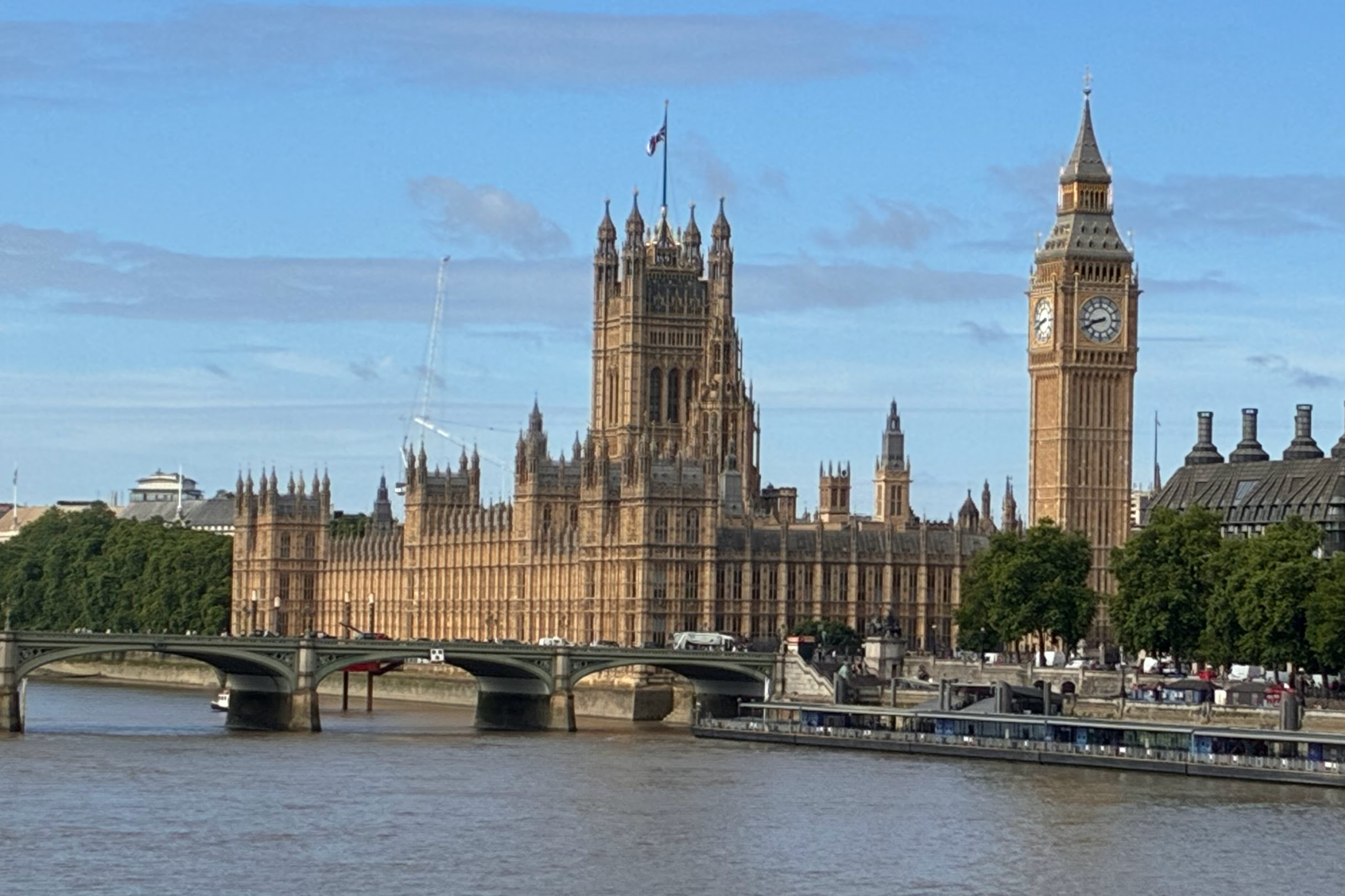
This particular 4th was spent back home again in Indiana on the heels of a trip back from London. While there is 70% of an essay about that trip and the British Museum sitting currently unfinished, the contrast between London (which is still the center of the universe) and the stretch where the glacier stopped that I call my hometown could not have been greater.

This weekend I took my two year old Betsy down to visit my surrogate grandmother Mickey Martin. Given that there are 99.5 years in between Mickey and Betsy and no genetic predisposition, there’s an obvious but inexplicable link between the two of them.

At Mickey’s were also my “cousins” her two oldest grandsons Chad and Andrew, with whom I’ve shared the vast majority of Thanksgivings and at least a bit of time in summers stamping down the cliff from Mickey’s house in Leatherwood Creek.

Leatherwood creek is between 12-30 feet wide, and rarely deeper than two feet. It winds around Bedford, through Otis Park Golf Course (which makes some bends quite nice for finding golf balls) past the valley where I grew up and eventually dumps unceremoniously into White River south of town.

It is objectively an unextraordinary creek in every way but one…it was mine as a boy.

This was the first time that I’d taken Betsy to properly play in the creek. Little different than when we were 5 or 8 or 24, Chad and Andrew and I were knee deep in that little creek, trying to catch crawdads and skipping the flattest rocks we could find.

Betsy, far from any reservations about these two relatively strange men or the creek, charged her little red knockoff Crocs into the reflected gold off that limestone bottom.

I’ve always been big on place. That place, without breathtaking vistas or world class fishing or any unique differentiator between it and a thousand small creeks running through rural topographies, is about as important as any other to me.

Heraclitus said that “a man never steps in the same river twice.”

(Heraclitus probably gets a little too much play on The Moorman Conquest, partially for my lack of witty Ancient Greek phrases to be pulled on command, and partially because I really love moving water.)

This aphorism can be applied to anything from hydrological flow constantly evolving a river to “generals always fighting the last war”.

Leatherwood Creek is different than I was when I was a kid, whether the fallen sycamores that have accumulated on the piling of the humpback bridge or the channel that cut an island next to what used to be the only flow strong enough to knock over a 10 year old. Compared to the differences found in all those other places where my feet have trod over the last 33 years, it is almost identical.

Being able to take Betsy there and seeing her joy in those humble ancestral waters that I once called mine, gave a sense of an uncertain trajectory that eventually orbited back towards home. Orbits don’t stop moving, but eventually one will come back to see the same perspective again, but with all of the knowledge gained in the interim.

This revolution around a woman whose characteristics I’d always thought of as with the raw, enduring and unstoppable power of a glacier, feels different. This is a woman for whom a Great Depression, a World War, six kids and a husband whose first heart attack was before 40, and unavoidable losses of 102 years of loved ones has yet to break.

As I showed Betsy, through the eyes of an eager audience for whom this was all VERY EXCITING, where cucumbers grew and where we got our worms from the compost pile and cooked crawdads over the fire on a flat rock, I realized how much of my life was formed between two acres and a creek at the bottom of Slaughter House Hill.

The worm bin in our back yard that Betsy loves to check on, the canoe leaning uneasily out of the bed of my truck, no less than the conversation with the Zimbabwean Minister of Mines in a London Four Seasons or a connection with the CEO of a 100 year old business in Germany in a town that globalization made redundant.

That place, and very specifically that 101 year old woman with a sweating blue Hamms Beer on the table always knew that no matter what aphelion that I managed to make it out to, gravity would always bring me back.  

Heraclitus might think that Betsy didn’t step in the same river as her papa, but I’ll just have to agree to disagree with him on that small point. I reckon his thoughts and mine on the concepts of logos and the necessity of counterbalancing forces for dynamic harmony.

That Parmenides of Elea was a piker anyway.

From West Baden to Baden-Baden

Baden Baden, Germany 10.5.24

Guten morgen from the famed springs of Baden Baden in the misty hills of the Black Forest. Being a sucker for UNESCO World Heritage sites and natural hot springs, when I needed a place to escape the city for the weekend before re-entering the working world, I immediately thought, “Boy wouldn’t Baden-Baden be amazing?” Turns out it is not only amazing, but remarkably cost effective (author’s note: this is all on a curve and this is still the EU, not 2014 Vietnam)

As Kit and I walked, slightly struggling from a few too many beers at Oktoberfest the night before, through the Residenz Museum in Munich there were a few random intellectual pursuits in my life that came neatly together. The incredible former seat of the Wittelsbach dynasty, the Residenz satisfied the peaceable goal of castle builders, to show in stone and gilt the immense power of a dynasty. Walking past the Bavarian equivalent of the Field of Mars in Ancient Rome, there was a feeling of comprehension when I felt like I’d seen it before. I had, festooned in Nazi paraphernalia from the black and white newsreels of Hitler’s rise.

Whether the Marshall Plan or the destruction wrought by two World Wars or just the petering out of the genetic predisposition, today’s Germans would be considered total impostors to the legacy of the Germanic tribes that were the terror of the Romans:

To quote our old friend Tacitus:

“Statim arma capiunt; non ante deponunt quam senectus. Nulli domus aut ager aut aliqua cura; sola regum liberi libertique armati agunt. Idque proprium et perpetuum signum est libertatis, arma ferre.”

“Arms are taken up at once and never laid aside; no one can go about unarmed. To carry arms is to show you are free.”

“Tamquam mollia et infirmi ingenii corpora labore quaerere quod possis sanguine parare.”

“They actually think it tame and spiritless to accumulate by the sweat of toil what they can gain by their blood.”

Today’s Germans are remarkably domesticated by comparison. A report that came out last week said that in the event of a real war for survival against Russia, the German military would have only two days worth of ammunition. To see that change in the lifetime of my “Grandmother” Mickey is one of modernity’s remarkable transformations.

Now after that digression, back to the point I was trying to make. The Residenz had a hall filled with the busts of Roman emperors and their consorts. It was nearly a full football field long, filled with all those old friends and monsters from Mike Duncan’s incredible podcast, The History of Rome. 

There was Augustus as both a young Octavian and the elder statesman who consolidated chaos into the peak of human civilization that would not again be seen for a millennia and a half. There was Vespasian, that humble soldier who merely laughed as courtiers brought him a family tree tracing his lineage to the gods. There was Marcus Aurelias, the last of the five good emperors, next to his grand mistake and heir, Commodus.

There was Septimius Severus, the first African to be hailed Emperator, and my personal favorite, the black sheep of the Julio-Claudian dynasty Claudius, who attempted to hide in a curtain assuming he’d be killed in the aftermath of Caligula’s assassination, only to be hailed as Caesar and arguably ruled as well as anyone not named Augustus.

To try to piece together the Latin names into the men whom I’ve read and listened to so much about was its own joy, but to see the importance that nearly modern rulers gave to the legacy of Rome nearly two millennia later made me think quite a bit about modernity’s proud disdain for the lessons of history.

From that grand hall to the hills of the Black Forest, Rome is never far away in Germany. There were no shortage of attempts to conquer the Germans. Marius, Augustus, Germanicus, Aurelias all had their run-ins with those warlike giants from the North, but somehow Germany was never fully Latinized. The spot where I sit today had the first Roman baths built in the time of Caracalla, one of the true monsters of the Caesars. The Romans were very serious about their baths, and seemed to set about building them just about as soon as the fighting stopped. This particular spot had no shortage of hot springs at over 150 degrees out of the ground, so it was a bit easier engineering feat than building a central boiler system as they did in other places.

Baden Baden was THE spa town for the European elite for centuries. I’m always a bit hesitant to describe healing properties to waters, but after five hours in one of the complexes yesterday, I can say that I haven’t felt quite this balanced in years.

It becomes ironic that this spot, with its millennia of history, happens to have a corollary with my upbringing in the hills of Southern Indiana. The sulfur waters of French Lick and West Baden brought the wealthy to what could have just as easily been a blank spot on a map. Grand dreams of the Carlsbad of America were hatched by businessmen (circus owners) in the late 1800s. The waters that had been used by Native Americans for healing purposes were commercialized and sold as America’s equivalent to Baden-Baden. Lee Sinclair built the world’s largest freestanding dome, which, at least anecdotally, had to be the tallest structure for 100s of miles. He filled it with neo-classical statues made from local limestone, mosaics to imitate the Italians, and brought plenty of Germans in to ply their ancestral trades as POWs from WW1. His creation brought characters as diverse as Joe Lewis, FDR and Al Capone.

Unfortunately it didn’t have nearly the staying power of Baden-Baden and fell into complete disrepair by the time I was a child.

While Americans don’t have nobility, we do have plenty of homegrown wealth, and in a fit of truly magnificent noblesse oblige, Bill Cook funded the restoration of the resort and dome to preserve these Hoosier architectural marvels in the late 1990s.

To be sitting almost 5000 miles away in the original is a really special experience.

But now its time to figure out how in shape my legs are. There are plenty of wineries in these hills, and I’m about to hire a pushbike to go see a few.

At least I’ll get to have some healing waters when I return.

Border Straddling in Estonia

9.28.24

Prague, Czech Republic

Wenceslas Square

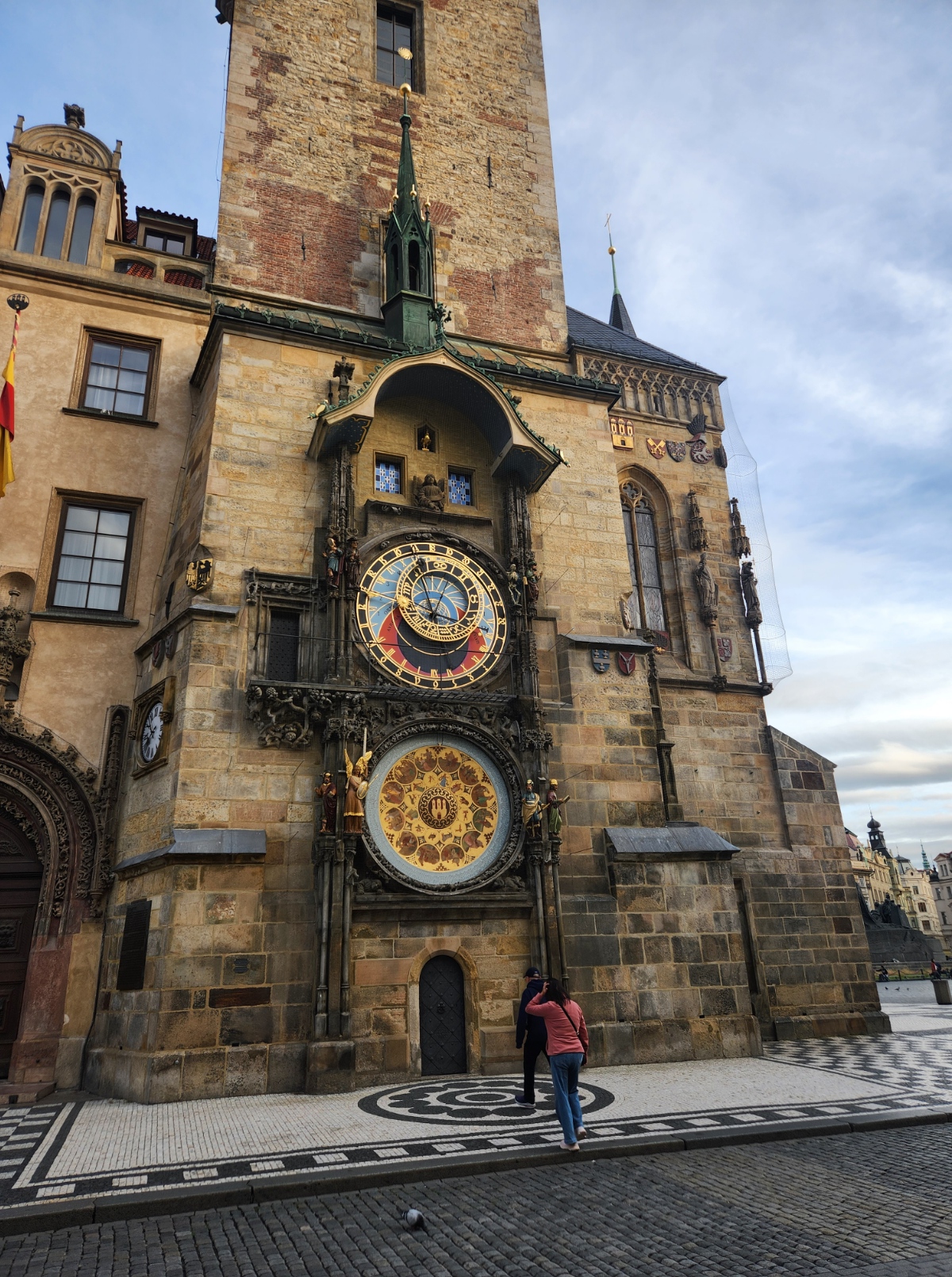
It is 8AM, which might be just about the only time that Wenceslas Square is not packed with people. There’s are still a small herd of Chinese tourists anxiously waiting next to the Astronomical Clock, and the dings of competing clocks are a nice accoutrement to the Dvorak occurring in my ears.

Kit arrived yesterday, and is still catching up on a bit of sleep, so I slipped out to do what I seemingly do best, come to let my fingers run until they find something interesting to tap out about the human condition.

I believe that I’d be derelict in my reportage if I didn’t start in Estonia.

This trip began cleanly enough. I was asked to speak at an EV Battery Recycling Conference in Frankfurt, Germany. Having plenty of reasons to visit partners in Germany/Belgium, that made sense. Then there was the addition of the Netherlands, for some scouting for additional opportunity.

Then there was a 95 degree day in Indiana’s most proudly German town, Jasper, at Strassenfest, that’s when things began getting interesting.

(Side note, as I sit here, I looked up to see a blue jacket with an IU hat on his head. As I do, I said “Go Boilers” to no effect. Being me, I then kept hollering until the guy stopped and turned around. Turns out he’s a Kiwi with one son at IU and another starting his PhD at Purdue in aerospace engineering next fall. The world is small.)

Sweating in the Southern Indiana heat, dancing an endless polka with Betsy, whose heat tolerance must be far more Nordic than her blood, Kit decided that she wanted to go to Oktoberfest for her 30th. Given that I was going to be in Europe anyway, she plied me with another large beer and suddenly we were going on our first joint European adventure. I talked her into Prague with a bit of relentless salesmanship, and she made it contingent on going to Salzburg to live out her Sound of Music fantasies in between. Having booked the tickets, I was then told that I needed to go meet the Estonian sovereign wealth fund. Changing my flight from Prague to Tallinn, I ended up standing on the Russian border in a former Soviet uranium enrichment facility.

Estonia has gleaned my respect for sure. Not knowing much of anything about Estonia besides it geographic location, there was a certain angst in Kit about the fact that I was going to be on the Russian border as the collective wars in Israel, Ukraine, and Lebanon kick off, with the Russians back on their traditional side of wherever the Americans are not.

I assured Kit that Estonia was no more dangerous than Boston, given that her former boss had brought them into NATO 20 years ago. According to Article 5, any issues in Estonia would be no different to the US and our allies than a bomb dropped on Manhattan. I’m not sure that this was a wholly comforting pitch, but it was effective enough.

As I landed in Tallinn, I went for a quick walk around the Old Town before finding something to eat. I ended up eating in a bar carved out of a meters thick city wall (bear dumplings and pilsner.)

The next morning I was picked up by my handlers from Invest Estonia to head to the Russian border. That was about a 2.5 hour car ride, which gave me plenty of time to ask all of the questions that my curiosity demanded. Estonia is a country of 1.3MM people. The fact that it has a unique culture at all is a millennium old underdog story, as for all but about 45 years, it has been handed back and forth between the Swedes, Germans and Russians as a particularly sought after piece of continental Europe. The two windows of true Estonian independence were from the end of WW1 to the start of WW2, and then from the fall of the Soviet Empire through today. Throughout all those changes of ownership, the Estonians have been able to keep a distinct language and culture.

Being that only 1.3mm people are native speakers of Estonian, they have become flexible by necessity in their willingness to open up to the world. Over 77% of Estonian adults are bilingual, with many speaking as many as four languages.  The post-Soviet era has made it one of the fastest growing EU economies, and they have a cultural willingness to look at the situation to find whatever narrow path of advantage that they can.

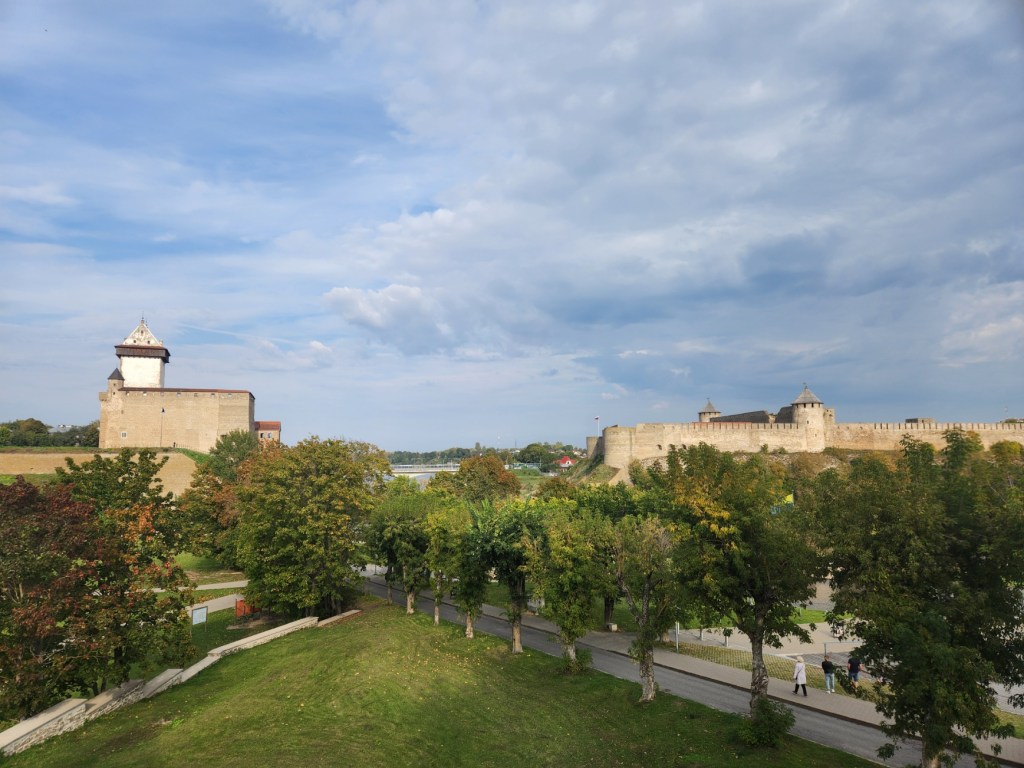
The two castles straddling the Russia/Estonia Border

Far from being culturally adjacent to Russia, they are much more a friendly Nordic country on the continent. Estonian language is closest to Finnish linguistically with plenty of shared words from German and Russian.

Ilmar and Toomas, my handlers, gave me a history lesson as well as an introduction to Estonian sauna culture. Let me say, as a lover of saunas, these folks have it down. On the beautiful coast of the Baltic Sea, we stayed at a spa/hotel which had no fewer than 7 different types of saunas. Dry, cool, hellfire, salt based, they had it all. They told me that the culture is such that this is a standard place to both have a communal sweat and get business done.

As Ilmar and I walked into the first sauna, there was a 20 something Estonian who could only be described as sturdy, beating guests wearing hats reminiscent of the 7 dwarves with bundles to oak branches, “to open up the skin!” This was followed by plunges in cold pools, introduction of juniper berry extract to the hot rocks, and no shortage of beer.

The competence of a culture that has always had to navigate between powers that were orders of magnitude larger than themselves was on display. These are folks that think through every possibility before deciding that there is a possible path to prosperity and going at it full tilt. Growing up in the warm embrace of the global preeminent power, wherein our errors are typically rooted in our overconfidence, it was a refreshing contrast.

Whether Luke Skywalker in Star Wars finding the one and only ventilation shaft that can bring down the Death Star or watching Purdue lose to double digit seeds in the NCAA tournament, I have grown to have a real respect for underdogs who carefully survey the situation, eliminating every potential path before betting the house on the one asymmetric bet that has a chance of coming in. Estonia is that underdog, and they’ve done remarkably well.

There were also some similarities between Estonia and Indiana that stuck out to me. The question of “What develops a cultural character?” has always been interesting to me. I have long posited that Indiana’s cultural character was forever changed by the Canal crisis of 1848. For those who have not found themselves immersed in Indiana history, I’ll give a brief synopsis.

In the middle 1800s, the success of the Erie Canal in opening up low cost logistics from the interior to the coast was looked at as a model for what is now the Midwest. Indiana, a young frontier state in its 30th year, made an all-in bet on the Mammoth Improvement Project, borrowing heavily to invest in canal infrastructure to help develop the state north of it’s Ohio River logistics chain. London bankers were courted, bonds were issued, and canals were dug from Delphi to Jeffersonville and all points in between.

Unfortunately, this all in bet happened roughly 10 minutes before interior canals were displaced by railroads. Indiana’s massive investment was stillborn, the state went bankrupt, and the lesson gleaned was not, “always search the horizon for the NEXT innovation” but instead, “never get too big for your britches.” Less than a decade later, Chicago became the hub of grain trading in the Midwest, and Indiana settled into a conservative, “don’t lose” mentality that made it a hub for manufacturing for the innovations of others. This might be a bit simplistic, but I don’t think anyone jumped on to  read a detailed dissertation of Indiana’s place in mid 19th century bond markets.

Estonia’s cultural outlook was defined by the fact that it never looked to expand its borders, merely keep the next landlords from entering the fray. As Ilmar spoke about the cultures of the different Nordic countries, he reminded me that Sweden was the only Nordic country that had not been dominated or occupied by any others, and this gave them a certain Nordic swagger not seen by the Danes, Norwegians or Finns.

For all that I know about Swedes, swagger would not have been on the top of the cultural characteristics list by any means, but these are the kinds of things that one learns while wearing a dwarf hat in a sauna in Estonia.

European history is the story of how those characters were formed and reformed over centuries. Whether it was a minor German princess sitting as the Autocrat of the Russian Empire or Vikings(Normans)  reigning as the masters of both Sicily and England, culture is a soup that takes on a bit of flavor from each random ingredient added, whether rulers or migrants or conflicts. Absent totalitarian eradication of a culture (which rarely works absolutely) a people will evolve alongside those characteristics that history has intertwined into their DNA (in both a genetic and abstract sense.)

Well the sun is rising and the tourists are starting to throng the square, so I’d better go find a bit more coffee and roust my beloved wife from bed. It is Saint Wenceslas’ feast day today, so I’d imagine that there’s going to be quite a hoopla that I’d hate to miss.

Musings in Montreal

There are few things that bring me more joy than listening to the gabble of a language that I barely understand in the background. Montreal is essentially the bunny hill of foreign travel…everyone speaks English, but given the choice, they’ll speak French. They are even quite kind about me trying to speak my broken French back to them (that sense of grande morveuse  seen in French in the metrepole seems to have been bred out over the past 300 years.)

Montreal is a beautiful city, a fusion of Chicago and New York with a certain old world charm that cannot be replicated. One can feel the French influence here in much more than the language. You can feel it on the sidewalk on a 75 degree night…partially because those sidewalks are filled with people who actually walk, but more so from the way that they dress. There are suit shops seemingly every third block, and women are obviously more influenced by Parisian fashion than the crass utilitarianism of Gen Z Americans.

I’ve managed to “collect” a fair amount of foreigners in my current role, which by no means breaks my heart. Kit loves to say that I collect two things, tribal masks and foreign men (I do feel like she’d be slightly more upset if I collected foreign women at the same clip.) My interesting position in the world of battery minerals and rare earth elements is a perfect place to make and collect foreign friends. Whether the Belgians in logistics or the German engineers or the Ghanian sovereign wealth fund or the Quebecois battery chemists or the Korean metal traders, there are few days when I speak to more domestics than imports.

Living in Indianapolis, a place not known as a magnet for immigrants, it is a welcome change of pace.

I have always thought that the immigrant story of “how you got here?” was one of the most interesting that could be told, but being in Montreal, a place that is jealously (and perhaps somewhat foolishly) protective of its unique French heritage, I find that I have a certain respect for the Gallic stubbornness that has kept Quebec, after two quintessentially Canadian (re:polite) attempts at a “Quexit” from the rest of Anglophone Canada, a place that sits in the middle of a jagged Venn diagram between its nation (Canada), its mother country (France), and its most important trading partner (US).

The economist in me completely understands how homogenization happens. To duplicate and translate everything for a population of less than 9 million people is…less than efficient. But for as much as capitalism has raised people out of poverty, it has also destroyed plenty that is “valuable but hard to quantify.”

Arguments against homogenization arise across many fields, from biology to education to culture. They are rarely successful, as one side shows up with numbers and heterogeneity shows up with a general feeling of “this could end badly.”

Let me tell you, numbers beat a general sense of “this could end badly” 99x out of 100.

As my mentor Doug Wilson once said to great effect, “More is not an achievable goal…it is just more.” Whether monoculture in industrial agriculture harming bees or Amazon destroying the local bookstore or China dominating the rare earth market there is a loss that is easier to feel than to quantify.

Modern man has traded instinct for spreadsheets, just as it has traded the 400 year old stone buildings of old Montreal for the big box store that will inevitably be torn down in 20 years, the quarterly profit of a corporation for the steadfastness of  Molson and Sons, LTD.

This is not some scathing critique or enlightened ephiphany, as I now look at Quebec as a nearly impossible place to do business for an Anglophone American with an aversion to bureaucracy, but a recognition that there is ALWAYS a tradeoff in decision making. What Quebec has kept in its heritage has inevitably cost it something in quantifiable economic prosperity. But it has kept something, like those little lobsterman villages in Maine or the UNESCO Heritage sites in German, that could never be purchased with a larger allocation of GDP.

Heritage is a much like land, there is an opportunity cost in keeping it, but once sold, it is impossible to get back at any price. As my astute sister in law once said, having read my favorite novel, East of Eden, “I get why this is Chris’ favorite book, its all about family and land.”

In a world where answers seem to be instantaneous and readily available, I find that the appropriate questions are asked less and less. I don’t pretend to have the answer for the balance between tradition and progress, heritage and modernity, I only wish that more folks would  bother asking the question.

But my steak tartare has arrived, and I never miss a chance to eat raw meat in foreign lands. The Quebecois have done a fine job of keeping this particular tradition alive.

Return to Argentina

Buenos Aires 5.12.24

Recoleta Neighborhood

In this 10th anniversary of the Conquest, as much as I’d love to drop everything and go do it all over again, the responsibilities of my rapidly approaching middle age make that an untenable prospect. However, life being as random as it is, occasionally I get sent back for work to places that have meant something to me.

Today I sit again in Buenos Aires, which remains my favorite big city on earth. The lament of wasted opportunity hasn’t changed much since my last trip here with Ben nine years ago, but there has been significant progress in the “right” direction. I often wonder whether Javier Milei will be looked at as a historical aberration in the long descent into madness known as South American politics. Even before the Bolivar the Liberator breathed his last, any semblance of unity of the former Spanish colonies had fallen apart. His personal sacrifice of fortune, comfort and station served not as an aspirational goal for the jefes and neo-gentry of the new world, but as a cautionary tale that made Shel Silverstein’s The Giving Tree read like Mein Kampf.Bolivar’s sacrifice showed the local powers that came after the colonizers the Nietzschean ideal of power over virtue. This grew into the neo-Marxism of the haves and the have nots, which saw political power not into a shared asset of the commonwealth, but a cudgel to extract the most for one’s supporters to the detriment of the opposition.

But as is often the case, I digress.

Today the exchange rate for Argentine Pesos to the Dollar is almost exactly 1000:1. My last trip here, it was somewhere between 9-10. While Americans have lost their minds over annual inflation of 6%, the Argentines are cheering the drop in inflation to 20% a month as if Messi had just scored 6 goals in a Copa Final.

I’m sure that Frankl or Maslow has discussed in much better reasoned arguments than mine, but the ability of humans to adapt to nearly any set of conditions, whether Inuit in the Arctic Circle or Caligula’s childhood subservience to the man who destroyed his family, never ceases to amaze me. Whereas I look at the price of a capital good and for most of my life assumed that it would be the same price or possibly cheaper in any 12 month period, in an entrenched inflationary environment, that is laughably impossible. However, the middle class Argentines have, via the invisible hand of the market, built workarounds to a currency that is not a store of value. Whether it is buying bitcoin, or utilizing the blue rate to sell Pesos for dollars above the “announced” exchange rate or buying stocks in pesos to sell for dollars, this is as natural as going to a grocery store for Americans. It is just the cost of doing life in Argentina.

As I asked my Argentine friend Vicky, whose roots in Argentina started with her ancestors fleeing pogroms in Russia in the 1880s, how does one make any sort of a contract with inflation as high and variable as in Argentina. She told me that a lease for an apartment is signed for 24 month periods, with a renegotiation on monthly rent every three months based on an announced inflation number. Her day job as a Chief of Staff for a logistics firm renegotiates prices monthly. As a sales guy, I just can’t imagine trying to build new business while monthly engaging in negotiations with my current clients based on a  number that…well as a jaded US economist I never believe any number coming out of the Bureau of Labor Statistics on either payrolls or inflation numbers, and I can’t imagine that incentives for Argentine bureaucrats are very different.

If anything, this only reinforces Adam Smith’s invisible hand argument. People will always act in their perceived self interest (this is not me subscribing to the rational actor theory of economics…As Benny always said, “don’t try to apply your logic to someone else’s situation, you’ll do your head in.”)

As the force of gravity ensures that water will always find its level, markets will find a way to emerge against all artificial constraints. In this age where “trust the science” has become more of a religious dogma than a reflection of the constant struggle of science to disprove any hypothesis, the futility of fighting against the free market seems to be a Sisyphean battle that global political leaders seem willing to engage in.

The entire concept of arbitrage is contra to value creation. While arbitrage (the simultaneous buying and selling of an asset in different markets to capture the “spread”) does end up creating value for an economy overall by diminishing rent seeking, it does not, by itself, create any tangible good or service. It is merely collapsing a market abnormality for the profit of the arbitrageur.

Arbitrage is created by asymmetries. These can be natural, such as informational arbitrage (the Rothschild network informing them of the 6th Coalition’s victory over Napoleon at Waterloo allowed them to make a fortune on the appreciation of English bonds before the rest of the market knew) but often times in a world with nearly frictionless information flows, arbitrage is found in the corners of regulation and government interference in free markets. If gasoline is subsidized in Argentina but not in Uruguay, it can be profitably bought in Buenos Aires and sold in Montevideo.  The profit of the arbitrageur is expropriated by the subsidizing Argentines.

Mankind’s ability to adapt means that no artificial system created by man cannot be subverted by man, any more than gravity can be subverted. There is an argument that the monopoly on force kept by governments can keep an artificial system in place, but history shows us that whether physical barriers, trade tariffs, or any other system is merely a dam waiting to crack.

Argentina’s current president, Javier Milei, is trying to shock a system with a cold turkey return to a free market. Like chemotherapy, the hope is that the cure takes before it kills the rest of the economy, and nearly a century of economic mismanagement means that there is quite the cancer to kill. By collapsing the informal exchange rate (the “blue rate”) to the level of the stated exchange rate, Argentina’s economy is forced to acknowledge the inflation that the official stats have long ignored, but eventually, this destruction of rent seeking by the state will ensure the stability that capital allocation requires for major investments.

In the short run, a lot of people will be worse off, but that sacrifice is necessary to build a foundation for long term economic growth.

I don’t know how the chainsaw wielding libertarian will fare. Half measures from a previous president, Macri, were unsuccessful as they sought to cause less immediate economic pain without producing the impact necessary for the population to start to see the “green shoots” of economic recovery. Just like trying to see results from 20 minutes of weightlifting, economic shock therapy takes some time.

Humans’ ability to adapt means that the absolute condition is less important than the delta, or change. The animal spirits that Lord Keynes speaks of are unleashed when things are better today than yesterday, regardless of how bad yesterday was relative to last week.

There’s an incredible feeling to be sitting in one of the 21st century’s grandest economic, political and sociological experiments. He is 4 months in, but has seen a budget surplus and a significant reduction in the rate of inflation. The long knives of the populist left are waiting for a chance to pounce, feeding their supporters on the saccharine lies of “the new system punishes YOU unnecessarily.”

I’m anxious to see the results, as an interested observer with limited skin in the game.

As Benny said nine years ago… “Goodcountry Argentina!”

Relational Capital and Sauerkraut

Hannover, Germany

8.20.23

Relational Capital

Ever since I was a little boy, I had a habit of rifling away petty cash in odd places in my room, only to come across it later. While this isn’t the greatest of investing tactics, it was better than spending it. Plus, there is always an odd amount of joy in finding money, even if I knew I had hidden it from myself.

I’m starting to see that I do the same thing with relational capital. Especially in foreign markets.

As I jumped on my first international trip since becoming a father, there was an odd tug that I’d never really felt before. There are few things in life that reliably quicken my heartbeat and put a smile on my face like jumping onto an international flight. The boy from Bedford always wanted to see the world, so whether it was steerage on Ethiopian Airlines for 14 hours from Singapore to Joburg or that first trip across the pond sitting between Alex Barnes and the woman who will forever be known as “the mother in law” who took up most of my seat while belching with a tenor and length that I have never again seen, I just love getting on planes with a passport in hand.

It was a little different this time as I kissed Betsy goodbye. 10 days is not an eternity, but she’ll be 13% older than she was when I left, and there was a tug there that I’d never felt. (This is NOT to say I do not miss Kit as well, but the beauty of marrying an independent woman is that frankly she probably enjoys the peace and quiet for a bit when I’m gone.)

As I jumped on my domestic transfer, I locked eyes with a guy who looked very familiar. Now I was flying from Indy, so that isn’t surprising, but when we both realized who the other was, he broke into that broad smile. Andre Benin somehow became my handler as I took the concept of a data center from a whiteboard conversation to steel and concrete on the banks of Lake Michigan. While my feelings on that project are still raw, given that my brainchild was, in the words of Kipling, “Twisted by knaves to make a trap for fools”, we still got Indiana’s first major Tier 1 datacenter built.

Outcomes being what they are, I learned a ton and know that I built something special even if I never got any credit or cash for the effort. The Bhagavad Gita reminds us that we are here to do our duty and that we should feel blessed to have meaningful work to do, regardless of the outcome. (It also has some bits about karma that I hope come true for the aforementioned knaves, but I digress.)

My duty has always been to my Indiana home, whether it was the badge on my chest as I screamed in the pits or breathing new life into a facility in Marion, Indiana that employed 4000 people the day I was born before being irrevocably shuttered 20 years ago. If meaningful work to be done is a blessing, then I will live a VERY blessed life in that respect.

As we walked towards our connecting flights together, mine to Berlin, his to Paris, we quickly caught up about the intervening years. In a 20-minute hurried airport walk, we smiled, laughed, and game-planned some potential collaborations in Africa. While we are in very different industries, contacts and geographies matched up.

That’s the kind of dividend that you can’t see coming from relational capital. Honestly, the chances of Andre and I ever doing anything together again from a business side are close to nil, but that isn’t why you have relationships. He is a great guy and we did something important together whether it was an airport connection or a random call in 10 years, either of us would have gladly helped the other.

As I landed in Berlin, I quickly texted Fabio, my travel buddy for a 5-6 week period during the original Conquest in 2014. Fabio and I have talked/texted regularly for almost a decade, and while I haven’t laid eyes on him in 9+ years, he and his wife Marleen have hosted my father multiple times and my mother once as well. There is a picture of them in the Babin, and the picture of us covered in Laotian mud still sits on my inherited “library” desk in my front room.

Fabio and I discuss a bit of this and that, the differences between business culture in Germany and the US, our perceptions of each other’s countries from the media, and we trade reading recommendations back and forth. For all the evils of social media, I’ve got to say that Whatsapp is one helluva upgrade from my father anxiously clapping his watch during the $2/minute calls to England with the Stall family when I was 10.

I’ll be staying with Fabio and his family over the next weekend, and I couldn’t be more excited. Marleen will tell me how when I repeat German phrases that it sounds like “You haff a mouth full of POTATOES” and their two little boys will wonder just what in the world this Yankee is talking about. But I’ll get to see the triplex that Fabio owns, understand what energy prices mean to him and his budget, will get to discuss over a map the differences that I saw on the train as I went from the former East Germany to West, and all the other things that books and media will never be able to personalize like the conversations of a friend.

Kit always says that I like to collect foreign men….which sounds much racier than it really is, but it bears no small amount of truth. Whether it was being able to ask Benny what someone thought about a situation in Brussels, and having a forwarded text response within a couple hours, or asking Vicky about the newest populist candidate in Argentina, and whether or not the inflation rate I read has anything to do with the actual situation on the ground, or my mate Glen talking about the absurdities of being a tradesman in today’s UK, these are real points with real people. I am very blessed to not have to take the media’s word as gospel about large swaths of the world. I have friends who can add color and context to a screaming headline.

The last year I’ve gotten to call on a lot of these relationships in my new role with ReElement. Who would have thought that my screaming at a Purdue/IU game in a Tribeca loft 12 years ago was going to somehow lead me to the White House and achieving my lifelong goal of getting quoted in the Wall Street Journal? Yet that’s what happened when I called Mohamed and said, “There’s someone mining lithium in Mali right across the Faleme River from Senegal…can you look into that?”

I’ve used it before in reference to an ill-fated bike ride without a map in Buenos Aires, but Prisig’s quote in Zen and the Art of Motorcycle Maintenance rings true with relationships as well.  

“You look at where you’re going and where you are and it never makes sense, but then you look back at where you’ve been and a pattern seems to emerge.”

Were I not so committed to Sulla’s Epitaph, that would probably be a decent thing to etch into my Bedford limestone grave marker.

As the majority of my writing has been letters to my future (and current) children lately, I haven’t been nearly as active in adding to the Conquest. However, something magical happens when I leave the shores of my homeland, my brain starts firing in a different direction, and my fingers start tapping out something beyond cliché drivel.

I hope to have some time to write more over the next 10 days. The decade that has passed since the Conquest has had no shortage of heartache, tragedy, and failure, but looking back, I have seen the pattern emerge. There have also been some great achievements, even if they didn’t all pan out as hoped.

The searching 27-year-old who took off with a backpack and a one-way ticket to Oz, hoping to replicate Dietrich Mateschitz’s feat of finding a multi-billion dollar idea tucked in some obscure Thai village is now a seasoned man. One with responsibilities, as well as the kinds of opportunities that that 27-year-old would have royally horsed up. The scars from battles lost and the wisdom of lessons learned, as well as the patience and polishing of my beloved wife, have set the stage for an exciting next chapter. Turns out that billion-dollar ideas can reside closer to home, whether in a lab in the Forney Building at Purdue or a little office 5 miles from home. Changing the world requires knowing the world, and I’ve been very blessed to have the desire, time, and money to know the world and to make real friendships with people from different walks of life on each inhabited continent.

Looking forward to some reminiscences this week with some of the Conquest’s early cast. Hope I can articulate them in a way that is worth a reader’s time.

Farewell to a Sir of the Highest Order

April 30, 2012 was one night that I’ll never forget.

Driving a 24-foot U-Haul through the crowded streets of Manhattan, I had the accumulated possessions of myself, Dane May, and Ryan Moore as we headed from our first NYC apartments in the Village to our massive (by NYC standards) flat in TriBeCa. I was driving while Dane sat in the second seat. Ryan was crammed into the middle area without a proper seat complaining that he had been smashed in like a secondhand accordion.

A few wrong turns due to some dodgy directions and we were forced across the Brooklyn Bridge with no alternative but to go to Brooklyn and turn around to head back to the island.

We arrived about 11:15PM to an absolute trash heap. More accurately, a series of trash heaps.

We would come to find out later, that the previous occupants had been bankers, and had spent the last week of their lease playing cocaine flip cup with a bunch of strippers.

8 million residents live in the island estuary for world human migration known as New York City, so the odds of knowing similar people seem low. But Manhattan apartments of a certain size gain their own patinaed verbal history, transmitted by the social connections of their rotating cast of occupants.

We had a U-Haul full of our possessions that had to be returned that night otherwise we’d be paying a $250 ticket as well as an additional day on the truck.

Our friends, lovable bro-snakes that they were, were there waiting to help us move in our stuff in. They laughed, well more of a hearty grimace with sound, as they walked into our “new palace.” Shuffling through trash as we tried to pile it all into the living room, we got our possessions inside and the truck returned about 3:00.

This was our 5 man “Snakepit”, and it was an adventure in anthropological studies. Whether it was DJ practice at 2AM on Tuesday, or me needing to cajole an aspiring model to scoot down the counter to allow me access to my 4 cup Mr. Coffee pot at 5:30AM before work on a Thursday, this was a jungle far from home.

It was neither clean nor comfortable, but it was a place of massive maturation. A few weeks after we moved in, Dane came to the roommates and said that he had a proposition. An Aussie friend of a friend, Ben Harrison, was moving to NYC for the summer and was trying to avoid hiring his own apartment. The nature of temp visas nearly always made this an “arm and a leg” proposition. He was offering to pay a chunk of rent to put a loft in our massive “activities” area, where we had a full-sized basketball backboard and a ping pong table. Always the cheap ass, I wholeheartedly said yes, and everyone else shrugged as they indifferently agreed.

Ben walked in wearing loose leopard print “pants”, a vintage hat pushed back on his balding head and large, odd rings on both hands. Upon his back, he had no more possessions than could be navigated while running through an airport. His voice had a tinny vibrato that would crescendo until he found a point to ask, “Right?”

He had been coordinating outdoor music festivals in Australia for years and was now looking to come over and scrap his way around electronic music in NYC. His girlfriend, Alice, was a dance captain for a Broadway show. Having avoided winter for 3 years at that point, this was an opportunity to steal a summer spending time with her personally while advancing himself professionally.

From almost no contacts save for club guys we knew, Ben managed to make himself invaluable to the electronic music scene, finally being given a 5% ownership stake of a club for sweat equity.

This wasn’t his foremost achievement that summer. That would be me.

I’d always had a desire to travel. My parents made the “interesting” decision to allow me and my slightly older friend Alex Barnes to go visit our friends‘ family, the Stalls, who made an ex-pat career move to London for a few years. At the time, it was a 12-year-old and 15-year-old navigating through England with only our paper traveler’s cheques and a tube map with a 20 pence piece taped to it, the Stall’s phone number scrawled across the front.

We survived, as one does, after several hair-raising adventures, discussion of which still brings tears of laughter to our eyes.

I’d seen quite a bit of the US between family vacations and getting to spend a school year traveling with my father as he hawked asphalt planers, stump grinders, and slot cutters across the US.

Internationally I was still a neophyte though, and Benny told me about his unbelievable travels over the past 7 years. He’d been to something like 35 countries at that point, backpacking through Europe and North Africa for nearly a year when he was 21.

This was the roundabout way he’d become our roommate, via poor directions and a deceptively named hostel/brothel called “The Heart of Amsterdam” wherein he met fellow Boiler Clint Misamore, both of whom had hoped to be in bed at somewhere OTHER than a brothel.

I was amazed that someone could do that. Vacations in the US were nearly always under 2 weeks, with the majority of one’s 15 days being spent on obligatory holidays, weddings, and funerals. I never envisioned time during my career to go travel for long stretches like Ben had.

It was interesting to discuss, but this was the life of someone else. I was a trader, and traders had to be trading. A week here and there might be taken off, but there was no possibility of taking a massive hiatus and expecting a job when I returned.

Fast forward 3 years, and I have since traveled to 5 continents and 18 countries. Ben and I as of 7PM local time on July 31, 2015, had joined the 5 continent club, having seen North America, Europe, Australia, Asia and South America together. Not bad considering we live on opposite sides of the world most of the time.

Ben taught me that there is no such thing as the “way.” There are only goals and the motivation to achieve them.

Every choice leads somewhere.

One day I decided the path I was on would only lead to a life that I was unhappy with, so I jumped off, and emailed Ben the following subject line:

“Quit my job. Need an adventure. Call when you can.”

Ben called within 12 hours from the other side of the world and within 14 days, I was en route to Perth with a backpack and little else.

That took me on the trip of a lifetime, and totally refocused my perspective from one driven by money and the status afforded it, to a life view focused on where I wanted to do legitimate good in the world.

It was a choice that would take me to a bamboo railroad in Laos, a yacht in the Whitsundays, an elephant camp in Thailand, and countless sleeper busses in between.

Ben Harrison was an engineer.

He was a network sustainability engineer. Ben saw the world as a treat to be consumed, and he found that the most efficient way to do that was by becoming an asset to an ever-expanding network of friends in different time zones.

Millions of people have connected at an event thrown by Ben Harrison over the past 20 years. From promoting underage clubs in Melbourne as a high schooler to the DJ booth at the world-famous Pacha in Ibiza and hundreds of temporary stages in grassy fields around the world.

Ben designed spaces and experiences where people wanted to find themselves.

Ben found plenty of connections as the keyhole for the parties he threw, but his never-ending craving for authenticity drove him to connect with people whenever they came within shouting distance of that tinny, Aussie rasp of his.

It was Richard, the Shakespeare of enlightened profanity cab driver in Perth.

It was Hein smiling through broken English as Benny tried in vain to discern a particular point of emphasis as we cooked the stuffed squid roles in Vietnam.

It was Gomez, a broke 18-year-old kid trying to make it in the music business in NYC that Benny brought along like a little brother.

It was Ariana or Nat or any of the other broken women who found an unexpected side in Benny. One that mended her broken wing and shared the security and affirming rush of initial intimacy…only to be put back out to fly with a smile and a lifelong friend and the knowledge that it could never be permanent.

Ben had an endless heart for people he “rated.” He had a tight list of Aussie insults for those who didn’t. This discernment was important because from Ibiza to Melbourne to Tulum to Tunis, Benny had a friend. I’d be surprised if the Council on Foreign Relations could activate boots on the ground so quickly in so many places.

Benny had a guy or a “bird” for everything. And as soon as they answered the phone, they started smiling as he asked, “How ya goin’?” He’d ask whatever was on his mind, say “great, I’ll connect you” and tell you to call the next time you were in XYZ.

Even if he’d called someone who couldn’t help, they’d always pass him along to a friend who could, because it was almost impossible to not want to help Benny. You could vouch for Ben because he was a professional vagabond, who drank champagne next to the grapes and every place it would ever be shipped. That is a widely sought-after profession that very few outside of English nobility enjoy. Ben was a gentleman in very specific ways, and his complex moral compass, while difficult to decipher, never, ever deviated. So long as you understood it, you could take it to the bank.

Ben was the most frustratingly selfish human being on earth. His personality was so big, that as colorful as I am, I was merely grey wallpaper in many rooms where the Benny Show found an audience.

Whether it was the $800 bottle of champagne that he ordered that you’d be expected to split or the plans that he’d unilaterally change if he met a couple of girls who wanted to join…or his utter intractability once his mind was made up, no one ever called life with Ben easy.

I’m sure Nigel and Kerry would say he was an absolute nightmare to raise. If there was a teacher in his entire academic career who had something nice to say about him, I’d be surprised.

He could be a little bit like the sun, life-giving when you need it and oppressive if you can’t escape it.

He lived fast and hard. But whether he’d lived another 2 weeks or 40 years, I am certain that he could not have died more peace with the life he lived.

Life was to be lived today, not in some indefinite future.

He did it his way and he let me come along. Ben Harrison taught me how to love the world as no one else ever could. Taught me that life is a magnificent set of possibilities for those who are free. Showed me that it is possible to be unapologetically yourself.

There were many lessons Benny couldn’t teach, but there were some that ONLY he could teach. I was truly blessed to have that hairy, Lebanese incarnation of Krishna show me the entire world of possibilities residing underneath his breastplate and mine if only we’ll get amongst it.
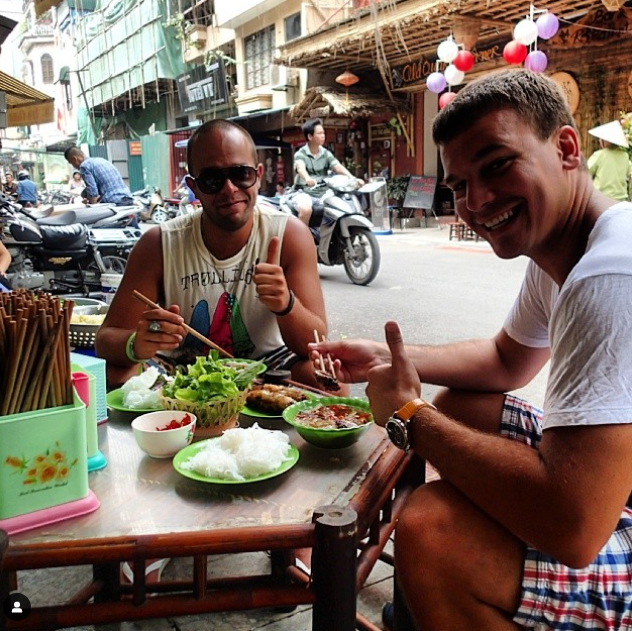
I’ll miss Ben for the rest of my life. He wasn’t constituted for middle age, so he shoved an entire lifetime into half of it, and lived knowing that he’d maximized every day he was given.

It’ll be hard to not have him randomly call from literally anywhere on the globe, talk about the Bombers latest defeat, some liquor rep screwing something up, and where he’ll be next month.

To know that I became the sole living memory of our experiences across 5 continents together is hard. Memory is only original so long as it is shared. Absent that, it is only a replica, with all of the defects, both subtle and substantial, that make a replica inferior to the original. The entire course of my life changed in the company of Benny.

It never would’ve happened had I not gone through a miserable night in a trash pile of an apartment, unloading three beds, couches and everything else up a 1.5 floor walkup.

It wouldn’t have happened if I’d merely laughed when Ben told me that a lifestyle of travel and freedom was possible for anyone, not just the lucky lot in music.

It never would’ve happened if one day I looked in the mirror and said, “the money isn’t worth losing your soul. Do something different or you’ll never achieve a goal worth a tinker’s piss.”

Here’s to two roads and choosing the one less traveled by.

It has made all the difference.

Thank you Ben. I’ll miss you brother.

Zac and Kurt

There are many odd ducks in this world, but those who truly enjoy the week before Christmas would have to be some of the strangest. Whether it is last second preparations; gift buying, packing for travel, odds and ends at work before a week out of the office, or that calendar-driven dredge of our mucked filled canals we call memory, there is no shortage of stimuli designed to throw a monkeywrench into this week before Christmas.

The last couple of years, I’ve gotten to add plenty to the monkeywrench pile, whether it was the first Christmas without Anna Zarse or last year when my family had to deal with the murder of Auntie Suzanne and the death of Grandpa after 50+ years of growing Christmas trees. Everyone has some hurt they are carrying around, and more often than not it bubbles to the surface during those short cold days in December.

Christmas took on a different meaning seven years ago for me after we laid to rest Zac Gary.

In one of the most poignant scenes in one of the all-time great television shows, Mad Men, Don Draper pitches his concept for the “Carousel” by Kodak, an automatic slide projector. As he shows pictures of his wife and kids, he talks about the meaning of nostalgia in Greek, which he says means, “the pain from an old wound.” By the end of his presentation, he has a tear streaming down his cheek, and others in the room have had to walk out to avoid breaking down in front of the clients.

Zac Gary became my responsibility before he became my friend. As an aggressively average athlete, but a willing team player, it was decided that I would be tasked with making sure that the best linebacker on our freshman football team would remain academically eligible. After a couple of trips to the counselor’s office, it was decreed that Zac Gary would be put in every English class with me and that I was to do everything in my power to keep him on the field with a passing grade.

Turns out, that is not the glamorous position on the football team that every little boy dreams about, but as a people-pleasing oldest child, I did what was asked.

Trying to get Zac to pass English was tough for a variety of reasons, his academic apathy being chief among them. However, by sheer determination, we got through Romeo and Juliet, Julius Caesar, and whatever other nonsense we were tasked with reading and evaluating.

Zac and I made quite the pair in an English class, the class clown and the bored debater who had been taught more rigorous English in 5th grade than BNL saw fit to teach sophomores. One of us was always getting yelled at, and occasionally we even deserved it. Mrs. Kurtz in particular took several stitches out of both of us as I informed her that the fact that my analysis wasn’t written in her teacher’s guide didn’t make it wrong, while Zac heckled her that Moorman knew more than the teacher in his froggy, adolescent, cracking voice that seemed to rise an octave every time he got excited. (We both got sent to the principal’s office for that one. It was an early lesson in “managing up” for me.)

Every time we had a paper, Zac would come rolling over in his rust-bucket brown S-15 that he was always perilously close to putting into a ditch at high speeds and we’d start working, by which I mean that I’d start working and Zac would pull out every weapon in his comedic arsenal to get me off track.

We made it through 4 semesters before no one could justify putting us in the same English classes any longer, Zac failed plenty of subjects, but English was not one of them.

After high school, Zac did what the boys of limited academic achievement did from Bedford, Indiana in 2005, he joined the Army and got an all-expenses paid trip to Iraq. I’m sure that Zac made a great soldier. He was quick with a wisecrack and the single most physically fearless person I have ever known. After 16 months in Iraq, he was given the Army Commendation Medal for acts of courage and heroism, before getting sent home to Bedford on leave around Christmas. I saw him once that Christmas break while I was home for Bedford, and something had changed in Zac and not for the better. War has a way of aging youth into something altogether different, and Zac was no exception. Unfortunately, home was more dangerous for Zac than a warzone, and he fell victim to an opioid overdose like so many have in rural America in the 21st century, passing away on December 15, 2014.

Not having my father’s native knowledge of arcane dates, I didn’t realize that it was the anniversary of that loss last Wednesday when Kit and I sat down to watch “Unstuck in Time,” the new documentary on Kurt Vonnegut. Vonnegut has long been one of my favorite writers, and as a proud Hoosier, his absurd
“science fiction” satire of a world that has lost its mind hits me on levels deeper than most.  

His most famous book is Slaughterhouse 5, which was a brutally tough book to write for the man who had been a prisoner of war at the age of 22 when the architecturally unparalleled city of Dresden Germany was demolished into a post-apocalyptic moonscape of death while he listened to the “footsteps of giants” from his underground slaughterhouse holding cell.

It was enough to make Vonnegut a lifelong pacifist.

In that vein he presented us with this poignant quote:

“What war has always been is a puberty ceremony. It’s a very rough one, but you went away a boy and came back a man, maybe with an eye missing or whatever but godammit you were a man and people had to call you a man thereafter.”

Having grown up with many of the boys who became men in the mountains of Afghanistan and the hellish sandy wastelands of Iraq, I understand the unfortunate truth of what Vonnegut is saying.

Recently I finished a biography of Robert E. Lee, which seemed a necessary supplement to my limited knowledge of the American Civil War. For all his notorious use as a posthumous symbol, while he ate, slept, and defecated, Lee was a man who attempted to act with his hardwired sense of noblesse oblige in the endeavors he undertook.

Generals, at least those who aren’t sociopaths, are forced to expend the lives of boys and men in pursuit of political aims, for as Von Clausewitz reminds us, “War is a mere continuation of politics by other means.”  

Even success requires that lives under a general’s direct command will be lost, and those losses affect the men in the command tent both specifically and in the aggregate. That takes a toll on any general whose humanity has not been completely lost.

It took its toll on Lee, and while his more ideological underlings begged him at Appomattox to disband the Confederate Army so that the men could carry out a guerrilla war, he would not subject his home to the brutality of hungry guerillas acting as brigands to continue fighting a lost war. That single act was arguably one of the greatest actions in American history.

Vietnam, Iraq, and Afghanistan showed us the cost in blood and treasure of trying to fight guerrillas in their native lands. Brutality, whether it be murder, rape or theft, are inevitable consequences.

Kurt Vonnegut was never a general, just a grunt looking to get through a war with his life and preferably all his appendages. He saw the meatgrinder that war had become, and saw that all glory in war was mere moonshine, even as he fought what he would always consider to be “one of humanity’s very few just wars.”

Vonnegut managed to speak to a generation during the Vietnam War, regardless of their race, status, privilege or class. He managed to speak to me as a Hoosier does, with that Hoosier accent that “sounds like a buzzsaw cutting through galvanized tin” even from the alleged silence of a typed page. While our Hoosier upbringings were about as culturally different as two men who grew up in the same state could have, with his family being amongst the pre-Depression German elite of Indianapolis surrounded by prosperous cousins, aunts and uncles and mine being in the little Rust Belt town of Bedford whose halcyon days ended 10 minutes before the Moormans showed up, there is always a level of unspoken understanding in any interaction between two Hoosiers.

Vonnegut’s contemporaries were drafted to the greatest cataclysm in human history, whereas mine volunteered to take the least shitty of the choices offered. We saw, him in real-time and mine with the distance of veterans returning, what war does to boys.

This summer, I became engaged in a short argument that was only kept from becoming vicious by the leash my wife so graciously yanks occasionally to keep me out of trouble. A man of no small means and four sons suggested sending the US military in to “clean up the cartels in Mexico.” My ire was raised by a few glasses of wine as he suggested how “easy it would be if we’d just go do it.” This man, whom I love as family, continued down this path until I looked at him and said, “So which one of your sons are you sending to fight this war?”

The leash was pulled forthwith.

Globalization and financialization have allowed Americans to “export unpleasantness.” We don’t think about the poor soul in Congo digging rare earth metals amongst toxic fumes as we mindlessly tap on our smartphones, and we don’t think about the men and boys that we sent to Afghanistan until our “cessation of hostilities” becomes a fiasco. We have the AMERICAN privilege of allowing all that unpleasantness to happen offscreen.

The first 14 years of my life were marked by the greatest rising tide of liberty and peace in human history, wherein the Soviet Union and the Lenin-Marxist experiment which brutally enslaved humans across the globe was shown to be a chimera.

Then September 11th happened, and the tide of human liberty reached its highest point and began to ebb. Pairing this with the explosion of the internet, a leveling mechanism unseen in human history comparable only to Gutenberg’s printing press, we found that freedom no longer looked very free.

We were told that the pursuit of peace required war, and having just buried 3000 of our countrymen, that logic held long enough to get us into two quagmires halfway around the world.

Those quagmires ensnared the boys I grew up with and turned them into men. Some of those men were irreparably damaged, while others came back ready to be upstanding citizens who worked daily to ensure that their children would have better options than volunteering for war at 18.

All this time, we fought a war on drugs, a war that cost us more lives than either of our military endeavors. All too often the victims of one war became the victims of another, and in my mind, those wars will always be personified in the acne-ridden face of a wildman with two first names, Zac Gary.

As we think about our blessings this Christmas season, all the while dealing with the bubbling of damaged emotions that the holidays so often bring, I’d ask you to do something positive with it. My personal causes of choice after writing this are:

The Wounded Warrior Project

Kurt Vonnegut Memorial Library

I don’t write professionally, but people seem to enjoy it sometimes. If you think you’ve gotten any value out of any of it, please make a donation in honor of Spc. Zachery D. Gary this Christmas season. I’d really appreciate it.

The Logic of Uncorrected Mistakes

I was once given a piece of sage advice by an Australian man much better at giving it than hearing it:

“Never apply your logic to someone else’s situation.”

Early Friday morning, I got to see that reality play out in a brutal technicolor. Over the course of 15 minutes, I watched as something as innocuous as a candy end a man’s life in a manner just as brutal as any bullet could ever be.

A single mistake took a man from being an otherwise healthy 31 year old to dead in less time than a TV sitcom. The stark contrast between my logic “Oh, looks good I’ll have one” to his situation of a life ending peanut allergy could not have been made more clear.

From the second I heard my friend scream, with an unmistakable air of panic in his voice, “Call 911 and find a goddamned EpiPen.”

My logic (or my lizard brain lack of it) immediately kicked into gear, and I was sprinting to ransack a pile of medical supplies while breathlessly trying to communicate with the 911 operator. The other person I was standing with had a completely different reaction and had no idea what had happened until midway through the next day.

Different logic, same situation.  

I find that the last year has thrust me into several situations where my logic was tested and questioned, by strangers and friends alike.  The morning of May 11th, 2020, I got a text from my grandfather’s cousin saying that my baby aunt was missing in Colorado. There was a posited, yet easily debunked theory about a mountain lion attack, which quickly gave way to an obvious truth.

My situation changed drastically that day.

That text kicked off a series of events that tore my extended family apart, showing the human frailty and the power of human delusion when dealing with seemingly inexplicable tragedy. To my logical mind, after asking a few questions of law enforcement about drag paths, blood trails, and the astronomically low odds of a mountain lion attack, I knew what had happened.

There had been a cold, brutal and narcissistic monster in our midst almost since my birth, and Auntie Suzanne had fallen victim to a collective ignoring of the elephant in the room.  

As her husband, the father of my cousins, quickly became the prime suspect, I watched the mental contortions of those around me as they tried to protect themselves from the brutal reality of a terrible situation. There was the straw grasping mentality of some, who nearly drove themselves to schizophrenia attempting to believe any scenario but the awful truth. There was cavalier vigilantism, the thought that “we know what happened, why haven’t they arrested him yet?” There was the sine wave of emotion trying to protect the fragile ego of those who loved her, attempting to tell themselves that “I wasn’t really that close to her.”

That advice that I’d been given in the punchy accent of my beloved dingo kicker rang in my ears, at a resonance nearly entirely drowned out by the buzzing of helpless rage.   

Even though we’d all lost the same person, who showed each of us a warmth and love inextricable from her character, our situations were not the same.

Nor was our logic.

As I sat outside that rustic cabin Friday morning, hands still damp with the residue of sweat from the chest compressions that I’d applied, death became as real to me as it ever had. All of the unnecessary deaths that had impacted me in this life came rushing back, from the violent death of my beloved aunt to the overdose deaths of friends whose logic and situation collided to end their mortal lives while creating carnage amongst those of us left behind that would last for far longer lifetimes.

That dependable God-given gift of logic left me without a shield for this tragic situation. Yet that advice drifted up to the top.

Suddenly, after all these years, I knew what he was trying to get into my head.

Self-preservation is a the strongest of our instincts. Freud’s fixation with the sexual impulse is merely a manifestation, as reproduction is just self-preservation by other means. The human mind can twist internal logic to protect itself from tragedy and destruction in ways that make no rational sense to a casual bystander. I have seen the twisted logic that my aunt’s murderer used to internally protect his Olympian yet fragile ego.

“As a Christian, if this tragedy caused one person to find Christ, it would have been worth it to Suzanne”

“When she married me, it was for life”

“I would have killed for that girl”

“I’ll do anything, I just want you back.”

All of these statements, taken in a vacuum, might have been true, yet when tied together after a monstrous crime, they represent such a perversion of right and wrong that it gives me vertigo.

I know much of the situation that created that monster. A narcissistic addict of a father tying the absolution of his failures to the athletic success of his only son, an enabler of a mother willing to look the other way at any sin so long as it didn’t deface the façade of a Christian family, and a wife who tried to compensate for her utter lack of agency with an internal warmth that she wrongly believed could melt the damage of a lifetime in her brutal husband.

His situation informed his logic, and attempting to apply mine to it would be like trying to read a book in French knowing only English. The letters might be the same and the essence of what the author is trying to elucidate is universal , but the system will never be able to compute.

As a Christian, I believe in the inherent brokenness of man. Call it original sin, call it mortality, call it whatever cultures as diverse as the Hindus and the Aztecs have, but that is a fundamental truth in every society. In my mind, that admission of brokenness is reassuring, because that admission of inevitable imperfection gives us the grace to stumble and rise again.

Taken a different way, that admission of brokenness allows us to view the situations and logic of others without the need to judge. Once one can admit how wires get crossed internally, it becomes much easier to give the grace we beg for ourselves to others.

Brokenness is no carte blanche for sins. As John Lennon said, “An error becomes a mistake when you fail to correct it.” Lives filled with human interaction will always be rife with errors, but it is our ability and our willingness to correct them that separates us from the logical computing machines that return DIV/0 when confronted with a flawed situation where immutable logic is applied.

Being confronted with death in the most graphic and physical of manners, I’ve been reminded how critical it is to attempt, with painstaking effort, to correct our errors before our situations pervert our logic and leave us defenseless against our inherent brokenness. Right and wrong are never so far away as our chivalrous children’s books would have us believe, but they are distinct nonetheless.

I’ll never be able to forgive a man whose brokenness stole Auntie Suzanne from me, sent the shrapnel of tragedy careening through my family structure, and left the wonderful, warm yet broken mother of his children in a series of dumpsters, but I can use that evil as a mirror into my own life, because that’s what my logic calls me to do.

Errors, they’ll be aplenty, but mistakes can be corrected.

Admission is a good first step.

Legends and Shadows

At a time when Western society has become diametrically opposed to the “Great Man” theory of history, I find that we are discovering new and interesting ways to sacrifice the good and the known in the Quixotic pursuit of perfection. Mankind has always sought to make sense of the seemingly random drivers of progress by attributing causation to a higher power. For the first civilizations that left us written accounts, there were attributions of gods and demi-gods: from Prometheus stealing fire from the gods, Achilles leading the Sack of Troy, or Moses calling upon Yahweh to close the Red Sea upon the Egyptians. The gods and the mortal foils that became legends in the retelling were the drivers of our inherited civilization and culture.

As history evolved from the fog of millennia, and attribution landed more upon flesh and blood men and women, our need for the legendary never waned, it merely transitioned from the gods to those people who drove the story like Napoleon and Caesar, or Catherine de Medici and Joan of Arc. While credit for the direction of history landed on mortals who walked the earth among us, the retelling made legends out of men and women who ate, defecated and died just like the mortals I see today.

I grew up in a community with a living demi-god. In Indiana, our gods sprang from polished hardwood with the same rapidity as a sharp dribble. In Bedford, Indiana, our demi-god went by a single name, as most do, and that name was Damon.

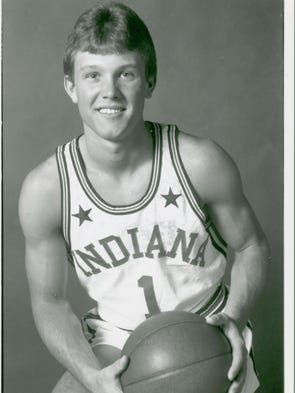
Damon Bailey was the greatest high school basketball player in Indiana history. In the halls indicative of the 1970s era building that housed Bedford North Lawrence High School, there was a mundane concrete staircase that opened up into a shrine, wherein an 18-year-old Damon Bailey stood in a life-sized photograph of an eager kid looking up with a basketball in his hand and the #1 jersey for the Indiana All-Stars that signified his status as Mr. Basketball in a state where no higher honor exists. The banner from his 1990 state championship still waves over the floor where I shot basketballs in gym class with much less success. In small plastic letters in a shadow case, his scoring record of 3134 career high school points is still seen by every entrant through the southern doors of the BNL Fieldhouse.

In front of his elementary school, there is a life-sized limestone carving of a 12 year old Damon shooting a foul shot. This statue didn’t seem out of the ordinary when I was growing up, because it was as much a part of the landscape as the hills that housed my hometown, but as I grew older, the realization of absurdity finally dawned on me that any 12-year-old had a statue created of his likeness.

Damon Bailey’s ascent to Olympus started with a book chronicling one of the worst seasons that another legend from the previous generation ever had to endure. That legend’s Christian name was Robert Montgomery Knight, but when he wasn’t being referred to as “The General”, he was known simply as Bobby. Bobby Knight coached IU to three national championships, and he had a winning record over every school in the Big Ten not named Purdue. However, Season on the Brink, was a book that showed in vivid detail, the reality behind a legend. In that book, a Bobby Knight said that Damon Bailey, at the age of 13 would be the starting point guard on a team with no less a starting point guard than Steve Alford.

Bobby Knight was an incredible hardass. He demanded total submission from his players, and used tactics to deliver that submission that could be most generously called “tough love” but was also accurately deigned psychological abuse. He had a moral compass that only pointed one direction, and often bulldozed everything between point A and B. His players graduated with degrees, and he took immense pride in the fact that his players were student-athletes, a quaint notion at a time when players are looked at more as unpaid professionals than students at all.

The General broke the spirit of more than one player in this 25+ years on the bench in Assembly Hall, but he created a fraternity of survivors that showed him deference and loyalty regardless of their post-collegiate successes.

As a 12-year-old, I watched a revolution as unthinkable as the Communists overthrowing the Romanov Czar, when Bobby Knight was removed as IU’s coach in the culmination of the most poignant Greek cum Hoosier tragedy ever written. The details are disputed and largely unimportant, but the first day that Bobby Knight was no longer prowling in front of the bolted down chairs of Assembly Hall was an unimaginable epoch shift.

Seeing that legend fall from grace had a lasting impact on my thoughts on the power of narrative and the transience of power generally. Getting to know one of Bobby’s in-laws well, I realized that for all his victories and legions of crimson clad disciples, he was just a man. Today Bobby is an old man, suffering with the inevitability of age on his body and mental acuity.

Status as a legend is no shield against the ravages of our shared mortality.

I got to see Damon up close, as a man who was a god from prepubescence evolved into a basketball dad in middle age. Being a Purdue fan in Bedford was tough, as there were no greater apostasy that to root against Damon and the General, so Damon’s effect as a living god was diminished if not completely muted on me.

The day after he’d blown a knee in one of the many barnstorming tours he used to make across the State of Indiana, he walked into the office in the athletic department where I’d somehow managed to take up residence as a “student assistant” and made a comment about my Purdue sweatshirt. “Moorman, why don’t you get an IU sweatshirt instead of that terrible thing?” I looked back in all the earnestness of a true Boilermaker believer and said, “Damon, why aren’t you still in the NBA?”

I’ve always imagined the confused look of Goliath the instant after a well placed stone from a shepherd boy hit him in the forehead.

On that day, I saw that look on the face of a legend, and this son of David caused it.

No one ever talked back to Damon. It was as anathema as cursing in front of the Pope.

In that moment, as I quickly scurried out from the blast zone as my athletic director nearly brained me for insulting our most important donor, I realized the truth about legends.

Behind the façade and the propaganda of their partisans, they are individuals who eat, defecate and die just like you and me.

Legends, like the local gods of ancient civilizations, can have immense power within their spheres of influence. Those spheres can be as small as a family unit or a small town, and they can span the globe like the legend of America’s Founding Fathers.  Regardless of reach, legends are only as strong as their perceptions in the minds of those who come after them.

As I’ve grown in age and experience, I’ve encountered many small sphere legends. My grandfather was one, the seemingly immortal Gene Moorman. He made a small fortune selling hot dogs, root beer and Christmas trees, and he lived fast and free in a way that made him a legend to the clock-bound wage earners of General Motors and Delco Remy in Madison County, Indiana.

They say that no man is a great man to their chambermaid, and Gene proved that to me. For all the people who knew that I was Geno’s grandson, and talked about how much fun it must be to have him as a granddad, few people knew the logistical reality of keeping that legend fed, watered, and out of harm’s way.

Gene was a legend for his defiance, and never saw himself as more than “a feller who wanted to find some fun trouble to get into.” For a living legend to be somewhat indifferent about how he is perceived doesn’t heap extra work upon the propaganda department. That was a blessing.

My brother and I got to see Grandpa for what he was, the good and the bad, and knowing him as a flawed man yet loving grandfather meant that we were never forced to measure ourselves to a mythical standard that started with a man and grew into an idealized legend.

To measure oneself against a legend can seed within the hearts of great men insecurities on par with those of an acne faced 13 year old attempting to “get the girl.”

Caesar was said to have wept at the grave of Alexander the Great, for his achievement of sole control of the Roman Empire was but a trifle compared to the man who conquered from the Aegean to the Ganges before the age of 33.

If comparison is the death of joy, then measuring oneself against a legend will be the root of one’s most virulent insecurities.

Having not been a legend, I hesitate to offer insight into how one should behave, but since I’m the man at the keyboard, I’ll nonetheless hazard an attempt.

For those living legends whose spheres are compact enough to have personal interactions with their most devoted disciples, I would proffer this:

Set your disciples free.

Make sure that those who view you as their yardstick of greatness know that there were failures along the way. Elucidate the mistakes, espouse your framework for decision making, and don’t be tempted into believing your own propaganda. Greatness springs from a devilishly hard to replicate cocktail of opportunity, preparation, and skill, but even when all those ingredients are present, it still takes more than a passing interaction with Lady Luck. Whether it was the woman who chose you over more traditionally appealing options or the chance conversation with a stranger that lead you to a great idea, there are inevitably moments in the story of any great mortal wherein circumstance allowed for greatness to spring forth.

As my first nephew was just born, I was thinking last week about the one wish that I would pray would come true for him. I settled on, “May his skills be suited to the era that he lives.”

Colonel Eli Lilly was the inventor who set the cornerstone of a great empire. His grandson, Eli Lilly II, was a consolidator and visionary who laid the framework for a global business from those inventions. Should Eli Lilly II have compared himself to the man from whose chemistry set created modern pharmaceuticals, he would have found himself lacking and run himself into the ground. Had Colonel Lilly been asked to set a framework for a global business, he likely would have found himself completely befuddled.

Living legends have a responsibility, an offshoot of that bygone concept of nobless oblige, to ensure that their great achievements do not hamstring their descendants with an unattainable standard. Great individuals are rare in their number but common to our species. The greatest of those individuals are the ones who ensure that their mortality is central to their story as to illuminate the reality of the possible instead of allowing an unreachable standard to become the omnipresent boogeyman of their devotees.

The older I’ve gotten, the more I realized that even within the most successful of people, extraordinarily few ever reach the Zen-like freedom from insecurity that onlookers might assume comes from their success. To be able to admit those insecurities takes a certain vulnerability. Even the greatest of men fear that their success is more fragile that most realize, or worse, that it is an outright fraud. To let one’s descendants know that insecurity lies within the breast of every mere mortal, is a gift greater than gold.

Vulnerability takes more than a bit of courage, and articulating it takes a heap time and some sustained practice. It is always easier to maintain that flawed bit of pride that says “I figured it out, and they will too.”

To truly be legendary, it is incipient upon those whose real, messy and flawed lives will eventually become the foundation for myth to let those who saw them in flesh and blood know that it wasn’t magic, and it wasn’t all roses. As Grandpa Gene used to say, “Some days chickens, other days feathers.”

Having made my daily bread for a time as a farmer, I can say with certainty that nothing grows to its potential in the shade. The size of a shadow comes not from the size of the object that casts it, but from the angle from which light is applied. If a legend truly cares about those closest to him, he must strive in word and deed to be straight with his disciples.

Everyone knows that the smallest shadows are cast at noon.