Same Same but Different

Throughout SE Asia, I probably heard the line a million times.

“Same same, but different.”

Whether it was someone trying to talk me into their restaurant or sell me “real” designer underwear at the market, the line became the English chorus in the teeming cacophony of mopeds, firecrackers and horns.

The most rewarding part of travel isn’t the places seen or the people met, it is the internal effect that it has on one’s viewpoints. It is looking at anything, old or new, and looking at it not as what you projected it to be, but as something closer to what it actually is.

I find that since getting home, I’m looking at many things that I took as routine parts of the landscape differently. The sound of walnuts and acorns rustling through limbs and dry leaves as they careen toward the ground had escaped my attention for 26 years, now it seems to be all I hear on my morning run. Perfectly spaced rows of drying corn suddenly possess a noble beauty that I had never appreciated.

Then there are the things that never bothered me, but now seem strangely absurd. Walking into a restaurant, and seeing the only healthy option to be a cheese, dressing and bacon covered “salad” is shocking after 6 months of eating little more than sliced tomatoes and cucumbers for a light meal.

The huge amount of trash that Americans generate on a daily basis, largely on the basis of overpacking everything, seems ludicrous. For instance, I bought a 2.5 inch long USB jump drive, and found myself bringing home an 8 inch by 12 inch plastic package, complete with a cardboard insert of nearly the same dimensions. All in the name of stopping shoplifters I suppose.

Also my relationship with the media has changed drastically. After a long hiatus from American news sources, I am continually shocked by the two pillars of American cable news.

Fear and consumption.

I challenge anyone to watch a news program with a discerning eye and find content that isn’t predicated on one (or both) of those pillars. From the comically fearmongering coverage of the Dallas Ebola patient, to the shamelessly consistent product placement (celebrities included) that passes as “news”, the American news media has largely ceased to serve any meaningful function within the democracy.

While traveling, I watched Anchorman 2. I loved Anchorman, but I thought that the sequel was merely a poor exercise in fill-in-the-blank jokes from the first film. However, I was intrigued by the satire of the cable news industry throughout, a point running behind the story line. Ron Burgundy becomes a late night news anchor on a 24 hour news station started by a fictional Richard Branson. After making an absurd bet that he’d beat the primetime ratings of a rival, he begins to run anything that people will watch from live police chases to cat specials, etc. His estranged wife Veronica has her once-in-a-career interview with Palestinian Yasser Arafat bumped off air by Ron’s coverage and commentary of a meaningless police chase.

In all of Ron’s blunders, he realized a fundamental truth. Viewers demand that their news be entertaining instead of informative. As I look at the state of our media now, nothing could be more obvious. Anyone able to string 6 misspelled inflammatory words together on a Twitter account can be a part of the broadcast.

We sacrificed insight for soundbites.

I decried in an earlier post the Donald Sterling debacle as being all about the wrong things, his team shouldn’t have been taken away for racist diatribes in a private phone call, it should’ve been taken away in 2003-2006 when he was being sued by tenants and the Justice Department alike for systemically racist leasing policies.

The difference was that generating outrage in the 2003-2006 period would’ve taken actual journalism, whereas a 10 second soundbite with that most dreaded of racial epithets generated more outrage than 100 well-researched articles would have.

There are countless things one learns during real travel, both about yourself and the world. The most impactful lesson will always be the learned ability to look at something for what it is, as opposed to through the societal glasses you’ve always worn.


The End of the Beginning

There are some things in life that can’t be forced. Reflective writing and bowel movements find themselves at the top of that list for me, but that very well might be more a manifestation of my last week than anything.

I am home. The Conquest has returned to the States.

I’ve been trying to talk myself into writing some sort of a concluductory post since Monday. I had 27 hours in flight to think about it, but I avoided my computer the whole time. I had a bus ride, a few quiet hours here and there, and finally a 4 hour staring match with a blank sheet of paper.

I just never could figure out how to force it.

Then, as most great ideas do, it came to me in the midst of a hot shower (shower temperature and creative output have a correlation nearing 100% for me.)

This post wasn’t meant to be a conclusion or a hasty recap of the last 6 months, it was yet another jumping off point.

The Conquest hasn’t ended, it has merely entered a new phase. Every idea has a life cycle, whether a business, a diet, a relationship or evening plans. There is the exciting “eureka moment,” there is the planning stage, there is the long (sometimes arduous) process of execution, and then there is always the inevitable evolution.

That’s what the Conquest is going through now.

I struggled all week about “doing the end justice” and pressuring myself to make this the best piece that I’ve written the whole time. It has driven my digestive system into a dither, but absolutely nothing had appeared on a page.

I wanted there to be some great takeaway, something gained from the last 6 months that I could point to and convince myself (and others) that “see, I knew I’d find my million dollar idea out there somewhere.”

Truth is, I didn’t even find myself. If anything, I now have a more ambiguous sense of self than I ever have.

And then I realized it.

No greater treasure will man ever find.

**********

Surrounded by a sensory overload of smells, noise, colors and people, I found a life without distractions.

The difference between social interaction and social media regained a clarity lost in the digital din. Shared meals showed why nearly every society makes hospitality and “the breaking of bread” a cornerstone virtue. I got to experience the shared attributes of humanity, those which transcend language, culture, politics or any of the other “higher forms” of civilization, to reveal the most basic of human necessities.

I found in the midst of abject poverty, the existential truth in Mark Twain’s words, “Comparison IS the death of joy.”

I saw all the complications of life slip away, if even only briefly. We are born, we love and we die. The only difference is our reaction to these intractable truths.

That slavery will exist always in some iteration is an inviolable truth of the human condition. The absence of physical chains hasn’t ended slavery any more than a cloudy night ends the moon. Slavery to opinion, to possessions, and to expectations are chains more powerful than iron.

The cruelest forms of slavery will always be self-inflicted.

I found that there is much more that unites people than divides. I saw, that outside of our protected zones of comfort, people will seek to connect rather than exclude. However, when the status quo becomes its own self-evident good, divisions both natural and manmade will seek to separate each from their neighbor.

I found sustainable living in a place where my bank account dropped daily.

The world showed me to be a fool time and time again, but acknowledgement of my ignorance was a comfort in itself. I found that those who think they know the most are always the least likely to learn, and I impolitely recused myself from membership in that self-satisfied group.

I found that a fight between two friends willing to listen to one another is one of the greatest tools for growth that man will ever find. I also found that some friendships are less permanent than we would hope, but that an end does not define the whole.

I saw the human condition at its most vulnerable, and witnessed the strength that it takes to be weak. Death comes for us all, regardless of color, income or location.

Fear only diminishes each breath that remains.

Like Cassandra foreseeing the destruction of Troy, I stood in the midst of the jungles of Laos with tears in my eyes that this too would someday fall victim to the unstoppable force of consumerism, a natural treasure sold piecemeal as presswood Ikea TV stands and glossy paper advertisements.

The dangers of confusing technical expertise with wisdom became clearer and clearer. Just as a man with a hammer sees every problem as a nail, so too does technical expertise lack the vision to see the unintended consequences of a “solution.”

As the West encroaches further and further into societies which grew up Darwinistically different values to our own, we will find ourselves trying to repair and improve mechanisms that we truly do not understand. Just as we have moved further from the values of our forefathers, cocksure in our belief that newer, bigger, and faster are self-evident goods, so to will we unintentionally destroy that which has bound vibrant communities together for centuries.

The list of observations I made could go on for days, but they all lead to the same inexorable conclusion. For all the knowledge that my travels afforded me, they merely showed how woefully insufficient the framework I use to cobble it together truly is. Only by acknowledging our own stunning ignorance can any of us hope to truly learn, and only by questioning those “truths” we’ve held as absolute can we ever be sure of anything at all.

Even as the world becomes interconnected at an ever increasing pace, it appears to me that individuals are retreating further and further into our own rigid beliefs. This would seem, to a mildly logical man, to be two opposing forces eventually destined for direct conflict. Will people simply pop their heads out of the foxhole after the battle occurs and acknowledge the “truth” as told by the victors?

History doesn’t seem to think so, although through most of human history, we didn’t encourage our best thinkers to become “excellent sheep.”

I hope to have avoided that comfortable affliction.

**********

The Conquest gave me what all great conquests will, the confidence to chase a new horizon.

I didn’t come back with a multi-million dollar idea and I didn’t come back with a groundbreaking novel in the can. I didn’t bring home the woman of my dreams (even if I now know a few locations where she might be hiding.)

I made some of the best friends I could ask for. I saw a side of myself that I didn’t think existed. I freed myself from the endless barrage of manipulated messages, both commercial and from a fear-inducing media, and the world I found turned out to be a safer and more wonderful place than I could’ve possibly imagined.

I saw that there are really a million ways to die, and that to live in fear of any of them is a fool’s errand. I made peace with a few deaths that I hadn’t properly processed, and I realized through bitter tears on an empty Thai beach, that you can say a proper goodbye to a loved one without a body or a suit.

I found friendships can be deeper after 3 days than some can after 10 years, and I saw the power of the human spirit in overcoming adversity.

I saw the good in man that I thought that I’d forgotten, and I saw some of the forgotten faceless in places that won’t ever get talked about on the news.

The man in the mirror looks back at me differently today.

He smiles a lot more. He reminded me that he’s the only one in this life that will take every step with me, and that if I don’t make peace with him, what the hell chance to I have with the rest of it. He showed me that I can be as happy in a bunk bed as I can in a multi-million dollar house, and that sometimes the best look we’ve got has a few tears running down our face.

I missed many things while I was gone. I missed a parcel of babies being born, and the weddings of some of my dearest and oldest friends.

Nothing is without cost, yet another universal truth that I uncovered.

The former commodity trader found that there are only two commodities that really matter.

Love and time.

As I returned home and picked up the 2 month old daughter of two of my best friends, I realized that instantly. Even if that were the only thing the Conquest had taught me, it would’ve been enough.

Thankfully it taught me so much more.

************

Thank you to everyone who has taken the time to follow my blog. The support that I’ve gotten from friends, family and total strangers who happened accidentally wandered on has been stunning and humbling.

I hope you enjoyed reading about it a tenth as much as I enjoyed living it. As I re-integrate back into “reality”, there will be more posts of reflection about some of the things I’ve seen and done. There will also be some thoughts on life back in the Western world as I re-acclimate myself to a reality that was once the only one I’d ever known.

If I can offer any advice on travel, the first piece is “Do it.” Anything more specific, please reach out to chrismoorman13@gmail.com and I’d be more than happy to offer tips or advice on any of the places I’ve been, or backpacking in general. We were all blessed with a wide and wonderful world on which to live, and it is a true shame to relegate ourselves to only the small corners where we were born.

Life as a hastily planned adventure works. Just poke around my ramblings and musings on this page if you need proof.

Wayward Sheep

Much has been made recently of a book by William Deresiewicz entitled Excellent Sheep. By most accounts, it is a scathing review of the highest echelons of  the American university system.  His main point is simple, we’ve created a system where entry to the top levels of society is predicated upon high achieving hyper-conformity.

Mountains of eerily similar student profiles litter the desks of admissions agents. Perfect grades, high SAT scores, and a carefully cultivated list of extracurricular activities are stacked in homogenous piles, waiting for a harried admissions agent to pick out the proverbial “needle in the haystack.”

How do so many high achievers end up looking exactly the same on paper? In an age where “individualism” is disingenuously held up as a self-evident virtue (the 40 other people at the train stop staring at their (I)phones are unique little snowflakes, doing exactly the same thing), how are we producing so many uniformly similar students?

I’ve spoken in earlier posts about the danger of narrow thinking. To pull some of society’s highest achievers into a conformity trap at a young age is condemning them to a life with a golden ceiling.

It prevents many of our best and brightest from ever trying their top gears, and we wonder why we have such high levels of depression in our high achievers. Life is great for a natural test taker so long as there is a test put on the desk. When the scantron becomes a blue book though, well that changes things.

Deresiewicz’s moniker of sheep seems harsh, but his point is that our high achievers have become excellent at doing what they’re told.

What are the long term ramifications for a society that promises security and wealth to those who show the most unwavering adherence to the script? Is our current political structure symptomatic of this thinking, so far as we’ve made no haven for truly dynamic leaders, only those who stick rigidly to the party line?

What happens to a society when our leaders are merely managers instead of visionaries? Like the multitude of blinkered horses dragging carts here in Thies, so many people are blinded to the wider world by the next task at hand. It is impossible to build an integrated sense of self if you are constantly waiting for an external force to reveal your next task.

It isn’t those tasks that reveal character, it is the introspection that occurs during and after. 2500 years ago, Socrates revealed that existential truth that “an unexamined life is not worth living” and it rings no less true today.

Unfortunately, the linear obstacle course only requires eyes on the horizon. The hyperlogical approach would say that there is nothing to be gained by looking around.

As I near the end of my trip, I find myself thinking more and more about my “place” in the world upon returning. I know, beyond a shadow of a doubt, my development as a person has accelerated beyond my wildest dreams. I can feel it instinctively, and I can see it, plain as day through my writing.

Taking the blinkers off will do that.

Yet, there is an element of fear creeping in as my return gets closer and closer. That nagging doubt that says, “All this was fine as long as you kept running, but the downside is coming.”

It takes a certain amount of confidence to take off and start an adventure, but that can be faked if you start at a bit of a run. Ending an adventure requires a confidence that can’t be faked.

In every cell of my body, I know that this was the right decision. But now, I’ve got to return to the “real world” where the sum of a person is distilled to a resume and a cover letter. Excellent sheep make for excellent resumes.

I guess I’ll just have to see what wayward sheep make.

Hopefully not dog food.

Emotional Attachment

Good morning from hot, sticky Thies.

While the Western world might not have a cohesive strategy for ISIS, Noah and I had a detailed strategy session last night to develop a plan for dealing with the hardened West African terrorists known as mosquitoes. Having been eaten alive nightly for the last 10 days, we had to change something in our tactics.

A 3 step plan, bug bombing the room an hour before going to sleep, drenching ourselves in repellent, and changing our potentially infested mats and I woke up with…considerably fewer bites. The cost of freedom from mosquitoes is high, and requires constant vigilance.

No one will sleep while these terrorists are at large.

********

Having had a week in Thies to interact with the kids, I’m starting to become unfortunately attached. We’ve already had some setbacks, with the Embassy denying a visa to one of our Academy students, Ibrahima, who had been given a 50k/year scholarship to the elite Hyde School in CT. The fact that a mid-level bureaucrat, who probably got his job by virtue of the US political patronage system, would stand in the way of a deserving kid’s immense opportunity is both heartbreaking and intensely infuriating.  

The loss to Ibrahima is huge, but the loss to the kids at the Hyde School is really no less. Typically, 50k/year East Coast prep schools are not bastions of socioeconomic diversity. The benefit to those kids through both the cultural interaction, and the fact that they will have a face to associate with West Africa would be huge.

Ibrahima, to his credit, took the bad news stoically. I’m not a terribly emotional person, but I would’ve punted a basketball clear to Mali. He stood there, as Noah told him, and then walked over to his friends with a body language that hadn’t changed. We’ll keep looking for other options for him, and he’ll keep working hard in the gym, perhaps with no greater end in mind than being better than he was yesterday.

All this because a stuffed shirt bureaucrat was told to reject more student visas.

We keep trucking though, working with other students in the hope that this was a one-off problem. One of the captains of the Academy, Abdou Gaye, is applying to a prep school in upstate NY to further his English and gain exposure for college programs. A quiet leader whose English is good until he psyches himself into a stutter, Abdou is exactly the kind of kid that we try to develop at SEED. He’s been in the program 3 years, passed his Baccalaureate exam (only 31% of the few who take the test pass), and has been selected for both the Basketball Without Borders and the U20 National Team. He met Noah and I for lunch to work on his application, and then sent us a heartfelt message for the help after we left.

We met him at the gym to play some half court last night. I should mention that we only have one functioning light at the gym, so half court is more of a forced activity after 8PM. The other side of the court was still filled with kids dribbling in the darkness.

I grew up with some gym rats, especially some of the kids at the Boys Club. Let me assure you, I’ve never seen anyone with enough desire to go dribble in the dark until someone boots them out of the gym.

I drew the unenviable task of guarding Abdou, which was comical for anyone watching. I shouldn’t be allowed on a basketball court with well coached 12 year olds, let alone a bunch of freak athletes, the shortest being a mere 6’6’’. Abdou threw down a couple of 1 handed slams in the 3 games, including one where he almost ran his nose into the bottom of the rim.

I just tried to shuffle my slow, white and old feet in front of him as much as possible.

Noah and I tried to exploit some teachable moments, especially with respect to the physicality of the American game. These kids are all stringbeans, as Mactar found out when he challenged the “toubab” to wrestle.

Listen kid, you might have a full foot on me, but your 160 lbs is NOT going to be putting me on my back. Try again in 40 lbs.  

The games ended when Thies suffered one of its many blackouts. We shuffled to the exit, trying to locate phones and wallets before calling it a night. I think there were still 25 kids in the gym when we left. 17 of them working in lighting categorized as “semi-darkness” at best.

Noah and I headed down the dirt roads back to the apartment, crossing the railroad tracks/dump, and asking “Ca va?” to the many families huddled around radios in the darkness in the “streets.”

It is fun to see the talent and it is amazing to see the drive. It is also heartbreaking to know that all the work these kids put in, both on the court and in the classroom, can be derailed by a bureaucrat after an interview that lasts less than 3 minutes.

The ability to have hard work rewarded is a fundamental component of the American Dream.

It is not however, a universal truth.

Discomfort and Perspective

For the second time on the Conquest, I’m settling in for an extended period of time. Noah and I got back out to Thies, yesterday (pronounced “Chess”) and got down to the business of settling in.

We’re staying with Sara and Laura, two Peace Corp volunteers who are partnering with SEED for the first time this year. Both are “hardened” Peace Corp veterans, with Sara spending several years in West Africa already, and Laura having come from spending a few years in Western Ukraine.

We rolled up to the apartment, and Sara took us to go pick up the essentials for living here in Thies. We went down to the “toubab” market, (toubab being a catch-all West African phrase for white/foreigner) and picked up some food.

The vegetables were bought in a transaction marred by badly broken French, from three austere looking women in brightly colored traditional get-ups. They sit for 10-12 hours a day under a makeshift umbrella fashioned from sticks and doubled up black plastic wrap. The most ambitious vendors whip around the tail of something to keep the omnipresent flies at bay, but most know a losing battle when they see one. The stench from the market was bearable today because it is dry, but it could make a seasoned garbageman retch after a solid rain.

OLYMPUS DIGITAL CAMERA

Having been in SE Asia, where everything is so cheap that it is comical, it is almost painful to pay the prices in the market here. Food is, at a minimum, 200% more expensive here than in Asia, with some things outstripping the prices I would pay back home. The prices of manufactured goods are also very high, although that is less surprising given the lack of manufacturing seen in this part of the world.

As we darted in and out of some of the “boutiques” looking for a frying pan, I came upon 3 men watching the Senegal-Philipines game. They were watching on a 20 inch tube TV, but they were into every shot, and they quickly realized a fellow fan as I swore when Gorgui got hacked in the lane. While we couldn’t really make out much of what the other was saying, the identification of a mutual goal was near immediate, and we shared the smiles of success and the multi-lingual curses of failure for most of the second half of the game.

It put what I’m doing here back into perspective quickly. These guys, standing and sweating in a storefront that might bring in $200 on a good day, had something to be excited about and there we stood, toubab and locals, swearing at a TV which would’ve been thrown out of most US households 10 years ago. It brought me back to the memories of childhood, watching Purdue games on old TVs, never thinking for a second that we needed to see the sweat dripping off of a shooter’s nose more clearly, just glad that we got to see it at all.

The unifying aspect of sports is powerful. In that moment, we transcended a cultural and language gap to care about the same thing, at the same time. For a few minutes in that shop, I forgot how annoyed I was at the heat and the stench. I wasn’t particularly worried about where I’d find fresh meat for dinner or the fact that there would probably be a blanket of flies at the apartment when we returned.

I just cared about a game, and about how my efforts were going to help the next generation of that Senegalese national team. I thought about Ibrahima, and prayed that his visa interview went well so that a kid who grew up in conditions that make American poverty look laughable, will be able to take his full scholarship to a $50,000 a year prep school on the East Coast.

And we’ve just gotten started with the girls. SEED has the ability to move the needle on female education in this country, and produce some of the best women’s basketball players in the world. Nothing increases human capital faster than increasing the educational outcomes of women, and we’ll be sending these girls to US schools in droves in the next few years. 

Then I thought, “Shit, I’d better work on fundraising to keep this dream alive.”

OLYMPUS DIGITAL CAMERA

We grabbed some sheets and a fan, and went back to the apartment to set up our “beds” which consisted of two cushions on the floor. I took my first cold shower of the trip, which was…quite refreshing. The fact that I won’t be seeing AC or hot water for a month is a little disconcerting, but roughing it is part of the territory here.

After we got our limited creature comforts taken care of, we headed over to the gym to watch the last scrimmages of the night and work one on one with a few of the kids.

The gym was probably 95 degrees at 8PM, but the kids were still clamoring to get on the court. Noah and I worked with Mactar, a 6’9’’ 16 year old who MIGHT weigh 160 lbs. He was one of the kids who was invited to play in the NBA showcase in Jo-burg. For about an hour after he was done with practice, he responded to every pointer Noah and I gave him, smiling the entire time, until we made him do push-ups, which was reminiscent of two strands of cooked spaghetti trying to stand upright.

Little extra chicken and some coaching, and the guys in that shop will be watching him some day.

My temporary discomforts look pretty small by comparison.


For more information or to donate to SEED Project, please visit www.seedproject.org

A Dickensian Quest

I was blessed with an unparalleled literary education as a child. Through happenstance and luck, Mary Barnes, the saintlike mother of one of my classmates, volunteered to take a group out of regular English and expose us to the sort of literature that reveals elements of the human condition, instead of being chopped apart for a 10 year old to be able to identify a protagonist and antagonist.

For years, she would come rescue about 6 of us from the monotony of textbook English and give us first the “Great Books” readers, then moved onto one offs with Gene Stratton Porter, Poe, and other authors of note. She taught us to consume literature as opposed to merely reading it. We’d debate and argue the motives of Poe’s villains, and contemplate in heartbreaking agony the plight of Porter’s immortal Limberlost orphans.

For all the thank yous I’ve meted out in this life, I’ve never properly thanked Mrs. Barnes for a piece of my education which has given me more than the rest put together.

On bended knee Mrs. Barnes, I thank you.

I thought of her on my 27 turned 30 hour train ride from Cape Town to Johannesburg. Most people would think that such a journey was a hellacious horror to be avoided at literally any cost. However, as an American, the novelty of train travel has not yet escaped me. Besides, there is a dining car and I still had a bottle of Pinot Noir from 2004 to keep me company. It couldn’t be that bad.

OLYMPUS DIGITAL CAMERA

Well had there been heat, I would have been correct. The Kalahari desert was getting down to about 15 degrees Farenheit, and that old steel box gets cold in the evening a helluva lot faster than it gets warm in the morning. I felt for a moment that my left asscheek and I were on the verge of ending our incredibly close 27 year attachment, but luckily that terrible fate was narrowly avoided.

OLYMPUS DIGITAL CAMERA

Given that you can’t really stare out the window at the fantastic beauty of the South African countryside for a day and a half, I got into my Kindle and found something to sink my teeth into. I decided to try my luck with that greatest of Victorian bards, Dickens.

Having failed to get interested in Oliver Twist once, I felt that it was my duty as a reader to find out what all the fuss was about.

For those unfamiliar with the story, the main gist is this. An orphan boy named Pip is mysteriously invited to the home of a wealthy recluse, Miss Havisham. Upon arrival, he falls inexorably in love with her coldhearted niece, Estella. One day he is informed by a lawyer that he has been anonymously bequeathed an allowance and estate in trust, which allows him to become the sort of gentleman whom he believes that Estella could love. His transformation and internal conflict from blacksmith apprentice to high society London gentleman causes most of the action in the tome.

Mrs. Barnes, why didn’t you tell me about this Dickens chap?

Having read more than my fair share of bildungsromans (new favorite word meaning book about one’s formative years) I was immediately drawn to the internal moral complexities of an old Pip looking back on this time in his life with both wonder and regret.

As he escapes his humble beginnings, he starts to find more and more shame in that which he came from. While I’m no Victorian orphan, I found a few parallels in my own life, as all good literature will show a determined reader.

I grew up in first wave of Midwestern economic decimation. The halcyon days of the major factory bringing prosperity to small communities across the Rust Belt were just coming to an end. My town had three major employers when I was growing up, a naval weapons base, a Ford factory, and a GM foundry.

These were places where solid middle-class lives could be built. Overtime paid the bills when times were tough, but the wages were quite high. People drove new cars because of the employee discounts, and it wasn’t rare at all to see a union guy on the line with a boat behind his truck on the weekends.

Then the party stopped. Globalization took hold, and the world realized that paying these wages wasn’t competitive against labor in the developing world who would happily do the same work for ¼ of the price.

The Ford plant shuttered its doors when I was about 13, and the GM plant started phasing out the legacy union contracts, hiring back replacements from my generation at half the rate that their fathers made.

So this was the economic reality that I grew up in. When people ask me if I grew up wealthy, I usually reply that I grew up about 2/3s of the way up an incredibly short totem pole.

My parents wanted to augment my education, poor Mrs. Barnes couldn’t be expected to teach me everything that I needed to know in the world, so they sent me during the summers to Northwestern University.

Boy did I feel like Pip then. I walked in having no idea what wealth or talent even looked like. I thought that owning a small town car dealership provided all the fantastic wealth that one could ever in his wildest dreams desire. Then I met a few kids from Lake Forest, on the famed North Shore of Chicago, and the world became a different place. The children of famed authors, doctors and CEOs were sitting next to me, wondering who let in the peasant with his one faded Abercrombie shirt.

I was again blessed with another great name from my educational past, Joan Miller, who taught me that rich kids have no inherent virtues impossible for the lower classes to attain. They are beatable, so long as you aren’t competing in the arena of consumption. It took me a decade or so to finally believe her, but it was one of the more valuable life lessons that I’ve been party to, and I’ll go to my grave thanking her for it.

And so from there I set out on my own Dickensian quest. To become one of those rich kids, while retaining the virtues of my humble beginnings.

In hindsight, I should’ve set off for the Holy Grail o

Much more easily attainable.

So I set forth, first to Purdue where I held my Bedfordian roots proudly for all to see. Perhaps too proudly, as a certain fur draped dame in Switzerland loves to remind me. I retained the twang that was so graciously beaten into me by my high school classmates and tried my best to retain those friends from home as we went down our diverging paths.

I watched as more and more of my friends from home found themselves recipients of all expenses paid trips to Iraq and Afghanistan, while my new friends at school wondered largely “just who in the hell was fighting these stupid wars?”

I got the distinct displeasure of burying a few of those former classmates of mine, as Bedford slipped from a thriving community into the throes of an unemployment/drug use death spiral.

Slowly my pride in being from Bedford was falling away. I knew that I could never go back, never again live in a place that harbored people who wouldn’t even help themselves. My love started to get callous, and my new line about my hometown was, “a great place to be FROM, not in.”

I saw this reflected on many others who got “out.” There was no intention to come back, and only a nostalgic pain that the place was going to hell in a handbasket.

From Purdue, I got into the rarified air of high finance. Now I was with people who really knew what wealth was. The kind who could buy my parents’ house 3 times over with a quarterly bonus check. They weren’t what you’d call “good people” but they seemed to like me and they loved the novelty of having someone from “the farm” around.

I think I inherently knew that I had, in Dickens’ words, “no hope of any personal participation in the treasure” but I felt like I almost owed it to everyone back home to find out what these “Masters of the Universe” were up to in their mansions and clubs.

So I buffed up my “talking points” about home and strapped it to my chest. Literally, I was IND in the oil and gold pits of NYC. I talked of the virtues of a small town life, like I was heading back there as soon as the closing bell rang. I spat with disdain at the nonsensical waste of money around me, at the slavish devotion to appearances, and the complete disconnect with what I considered to be “the real world.”

At first it was just an act; I loved it all. I loved the glitz and the glamour. Beautiful girls from all over the world flocked to NYC, and having Easter dinner with a federal district judge in a 20 million dollar home in Connecticut, drinking $500/bottle wine was a dream come true.

I had arrived.

Unfortunately, as any good actor will tell you, at some point the character will consume you if you play him long enough. It gets even trickier when the character you’re playing is an earlier iteration of the man in the mirror. At some point I was trapped, between putting up a false face of disdain (outwardly failing in my initial quest) and actually embracing the life that I had come to enjoy.

Oh but fate’s means of arranging roadside conversions are unparalleled.

There wasn’t a single “scales from the eyes” moment, but one day I woke up and knew that the character I had been playing was right. This was absurd and it was unhealthy.

My rich friends had drug problems of their own, they were just with the more socially acceptable cocaine instead of homecooked meth. The jobs they held were given to them for one reason or another by some backslap connection, and they felt no real sense of satisfaction from any of it.

Those who had grown up in more humble circumstances were no happier, as they’d let their Pip die years ago, content to drink and womanize instead of thinking about the bigger picture.

The whole “scene” that people were so desperate to integrate themselves into was just a flashy set of distractions from lives neither fulfilled nor examined.

Some of the only people I met in the whole ordeal who were actually happy were the two idealists I found running the SEED Project. They’d both grown up in the rarified air of the NYC elite, but they were running an engine for the betterment of their fellow man. You could see it on their faces.

Graduates of Princeton and NYU, they’d seen all that money and the “scene” had to offer, and they made a conscious decision to work for an amount of money which would be considered poverty by any of their well-heeled contemporaries in exchange for having the creative ability to change the fate of children (and eventually a country) halfway around the world.

I was drawn to this, at first for the basketball (I might be a Purdue fan, but it still fills my heart with pride that Damon and the 1990 Stars hold the record for most people ever at a high school basketball game) but eventually for the stunning opportunity to actually HELP someone.

My own cause from home, my beloved Thornton Memorial Boys Club, was gutted by a group of people slightly higher on that very short totem pole. One by one, the men who had taught me the value of service unto others, men like Jim and Jeff Jackson and Jimmy Gratzer were fired through the petty small town machinations of a cabal of people whose collective ego far outweighed both their talents and abilities.

I needed something towards which to redirect my efforts. Something bigger than myself or work, and something outside of my on-again, off-again love affair with my hometown.

Noah and Romola generously offered to let me come help, so now I’m on my way to Senegal.

The race hasn’t finished yet, but my quest was always two fold. I’ll worry about the money some other day, best to get back to those small town virtues before they’re lost for good.

Another wise woman from Bedford once told me, “what of a man who gains the whole world but loses his soul?”

Mickey, turns out I don’t really want to find out.

From Main Street to Wall Street to no streets, the quest continues.

But Bedford, I miss you more than you’ll ever know.

An American Lazarus

Good morning from Singapore.

Waking up curled over two chairs in the Singapore airport, contorted into a fetal position far too compact for my size, I’m thankful again of my “superpower.”

I can fall asleep anywhere, anytime. And it doesn’t matter if a freight train or a hurricane is coming, you’ll have to send someone to roust me.

Spiderman can keep his webs, and I never really wanted X-ray vision anyway, Superman. I’ll keep my weaponized narcolepsy. It has served me incredibly well, especially in the always fluid sleeping conditions of Southeast Asia. Whether a dorm full of incredibly drunk 19 year old shouting Brits or the coffin berth of a 12 hour sleeper bus, I slap on a history podcast and I’m out faster than a fat kid in dodgeball.

The older I get the more I realize how fantastic this ability is.

I’m leaving Southeast Asia tonight, headed onto South Africa. I’ve spent the last 3.5 months on the adventure of a lifetime. I experienced the horrors of war, as well as came to a better understanding of America’s legacy in Vietnam. I got an up close view the charismatic, maniacal and efficient evil of the Khmer Rouge in Cambodia.

OLYMPUS DIGITAL CAMERA


I saw some of the most beautiful natural places on earth, from 5 mile long caves to pristine waterfalls, untouched and underdeveloped.

OLYMPUS DIGITAL CAMERA

I got to walk in the ruins of one of the ancient wonders of the world, Angkor Wat.

OLYMPUS DIGITAL CAMERA


I played with monkeys and rode on elephants.


OLYMPUS DIGITAL CAMERA

I wrecked motorbikes and taught monks English.

Where's Switzerland again?

Where’s Switzerland again?


I got to see a military coup first hand, and debate political issues with people from a half dozen countries almost nightly. In three weeks I developed a bond with a man who taught me a lot about addiction and even more about the human condition. I saw a girl who was incredibly lucky to “only” have 40 stitches in her head, and I saw a surfer who was not so lucky as his lifeless body was pulled from the Bali barrels.

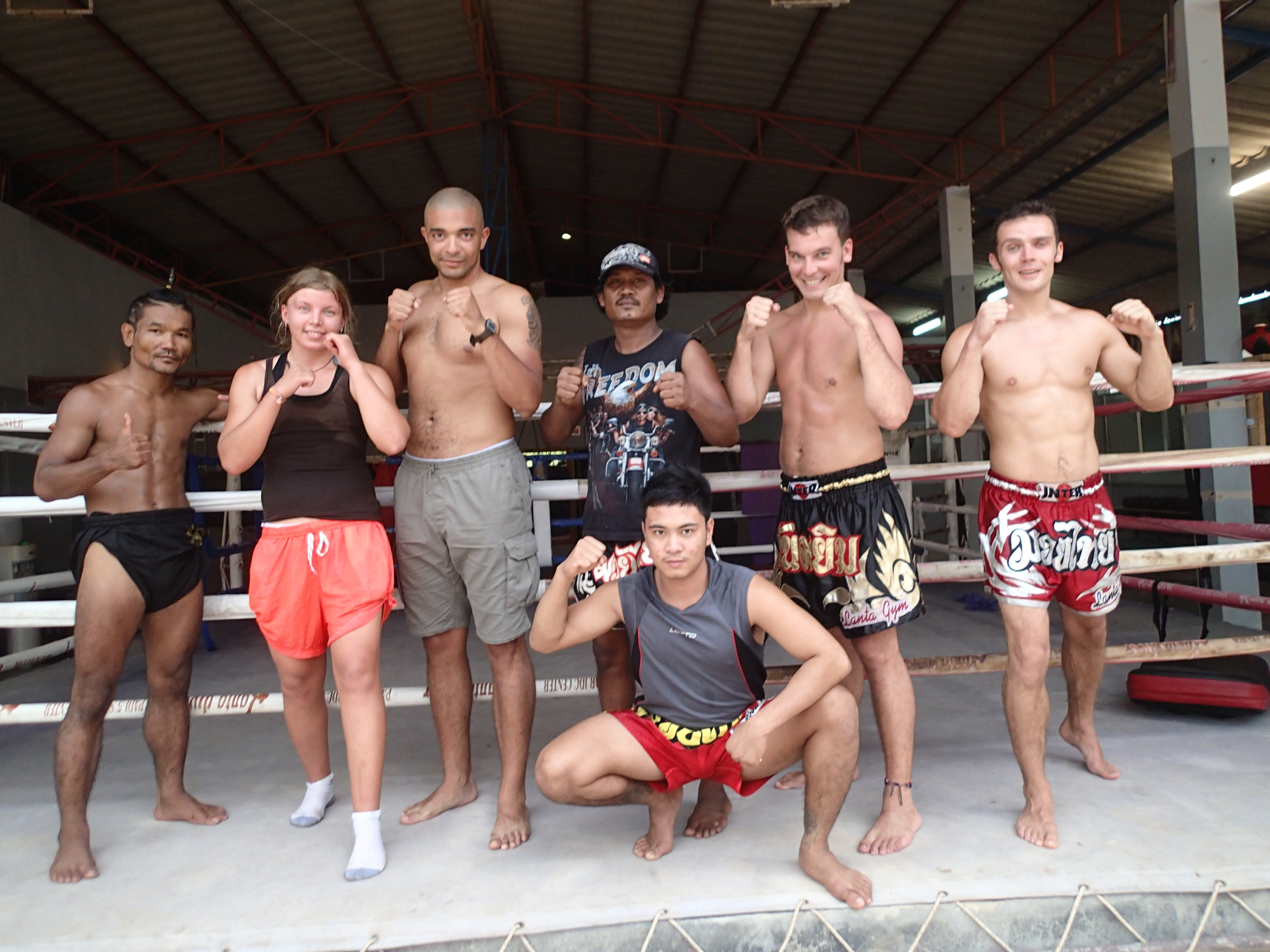
I agreed to travel hundreds of miles with people I’d met mere minutes before and “evaded” organ snatchers in remote Laotian towns. I learned to communicate with only hand gestures and a smile to bridge a language gap. I learned the art of Thai boxing at the hands of gentle madmen, and learned to cook the cuisines of a half dozen nations.

Belgians, Finns, Limeys and Thais

Belgians, Finns, Limeys and Thais

In short, I lived life. Frankly, a helluva lot of it. I grew more than I would have in the next 5 years of my “normal” life. I was in more uncomfortable situations in 100 days than I can count, but I managed to make it out of all of them with barely a scratch.

They say the best journeys are the ones where you find something you didn’t know you were missing. I found something better.

I found a man that I thought died years ago. A guy who laughed first and frowned rarely. The one who looked at the world with the endless optimism of the boy taken to a barn full of horseshit, started smiling before saying, “There must be a pony around here somewhere.”

He looked a lot like a guy who had become a nasty cynic. One who had been paid well to delude himself into thinking that he was smarter than everyone else in the room. One who thought that a growing number on a bank account was going to magically fix an unfulfilling life. One who had put a reckless love of risk before an awful lot of things that actually mattered in this life. One who’d forgotten that the happiest moments really are free, or damn near to it.

It isn’t very often that someone crawls out of an unmarked grave, but I’m glad I came across it.

That’s what meaningful travel does. It reacquaints you with the best versions of yourself. It shows you overcoming obstacles to reveal a character and mental fortitude you didn’t realize that you’d had.

And thank God it does. Otherwise I wouldn’t have found that man I thought had died. And he’s a helluva lot better than the one who got on a plane in Chicago in March.

Farewell Southeast Asia. You’ve done more for me than you’ll ever know.

Dreams Worth Having

When I left on the Conquest, there was a nagging voice in the back of my head.

“Be serious. Act your age. You’re just running away from your responsibilities. Everyone else is getting married and having babies, and you’re going to burn through your savings to chase what?”

Expectations and societal pressures have a way of doing that, creeping into one’s psyche so deeply that we can’t differentiate the desires of our own heart from our (insert years here) of intense training.

It doesn’t matter if you’re 5 or 15 or 50. Society has a set of expectations for you, and acting outside of that framework is considered risky behavior. Why not stick on the main road? It is safe there.

Not the main road

Not the main road


“It worked for Larry and Suzy and Paige. Hell it even worked for Bob, and we all know that he’s not playing with a full deck of cards.”

Societal norms end up being codified “best practices.” People wonder why pork isn’t eaten by in Kosher (Jewish) or Halal (Islam) traditions. Have a nice case of trichinosis and get back to me. The origins of both of those religions were in the desert nomad way of life. Pork goes bad…fast. It doesn’t take too many people keeling over from food poisoning or trichinosis before someone says, “hold on, maybe God doesn’t like this.”

After a few thousand years, that social more becomes ingrained well past it’s “consume by” date. Modern refrigeration makes the consumption of pork no more dangerous than any other meat, but the taboo continues.

Modern society is no different. “Get a job, find a nice girl, buy a house and pay down your mortgage. And STAY MARRIED.” This path was a road to success for generations. People lifted themselves from squalor and into situations that their parents only dreamed about.

Then in America we started bumping up against a dazzling diamond ceiling. The dream ceased to be “become a homeowner” and began to be about owning a BIGGER house or a MORE EXPENSIVE car. We substituted aspirations for a better life for a desire for the meaningless and ephemeral “MORE.”

That house is a bit less than 4000 sq ft, but everyone there seems happy.

That house is a bit less than 4000 sq ft, but everyone there seems happy.

As far as standard of living goes, there is no reason that a family of four in a 4000 sq ft house is better off than a family of four in a 2000 sq ft house. Unless playing hide and go seek from our family members is considered a material good (which in some families it might be) we’re accomplishing nothing besides paying to heat and cool unused space.

Driving a 10 year old Chevy Impala and driving a brand new Mercedes SLK has absolutely 0 difference on one’s quality of life. If both cars function properly, both cars will get you from here to there without walking.

I'd take a bamboo platform, 2 railroad axles and a gas engine over an SLK any day...

I’d take a bamboo platform, 2 railroad axles and a gas engine over an SLK any day…

That iPhone 5 in your pocket? There is only the barest of marginal difference between that and an iPhone from 4 years ago. If someone says, “but it is faster” I want them to ask themselves what they actually accomplished with that half second saved. Did you get a half second closer to learning Spanish? Or maybe you used those cumulative half seconds to cook a healthy dinner. If so, fantastic, the new iPhone has made your life better.

If you played Candy Crush for 45 minutes today, your life didn’t get better because your phone was faster.

Technology has gone from making our lives markedly better, to making us notably more distracted. We call ourselves busy, yet no one in America (or the rest of the First World for that matter) has ever been forced to carry their drinking water from a well, chop wood to heat a home, or butcher an animal to have dinner.

We’ve started to concentrate on the margins. Utility is ubiquitous, so instead we concern ourselves with unnecessary luxury. There will be people lined up around the block to pay $500 for the next iPhone. Between the time they spent waiting and the money they paid to replace the perfectly good phone in their pocket, what could be accomplished?

Get on kayak.com and check out the Explorer function then get back to me. $500 can almost assuredly get anyone in America a round trip plane ticket out of the country.

Our society doesn’t look at this as a sickness, but it really is. We’ve been so conditioned to believe that “new” must be “better” that we no longer look at whether there were any material benefits.

According to 2007 New York Times article, Americans see more than 5000 commercial advertisements today. That is just shy of 1 every 10 waking seconds. Can we really act like this has no effect on our internal thought processes?

No billboards on this "highway"

No billboards on this “highway”

If society can delude itself into mass hysteria about something as simple as a smartphone, why don’t we examine those other mores that society tells us? Do we look with an objective eye at the “why” of those “best practices”?

We blindly push more and more kids into college without any serious consideration of alternatives. Nothing screams “blind tradition” like sending a kid to learn about the internal rate of return in business school but never asking him to run that calculation on his own college debt and future earnings potential.

In the same vein, nothing screams crazy like America training our future “world leaders” while never sending them outside of the country.

For all my initial fears that I was “running away” or “keeping my Peter Pan tights on a little too long,” I finally came to the realization that the safe, conventional road wasn’t right for me.

I also realized that some of those moderating voices in my conscience aren’t actually “me.” They are an echo of everyone else.

People always tell kids to “chase their dreams.”

Almost no one says, “first, make sure your dreams are worth having.”

Seemed like a dream at the time

Seemed like a dream at the time

Is having a big house and an expensive car a dream worth having?

Well…maybe for someone? I think most people just do it because they listen to the voice in the back of their head saying, “Let’s be “better” than our parents. Let’s be “better” than our friends.”

That’s all well and good, but we’ve got to remember to look at what actually makes something “better.” To the kid from the wrong side of the tracks in Speedway, Indiana, the Chicago suburbs seem like heaven on earth. Everyone has a college degree, drives a nice car, vacations in expensive places, and there are more culinary choices than Gene’s Root Beer and Applebees.

You can wear argyle socks and sweater vests without being laughed at, and leather shoes are encouraged instead of scorned.

At the end of the day, he can look in a mirror and say “I’m better off than everyone back home.”

But did he ever look in that mirror and ask, “Is this really the life of my dreams? Or was I so concentrated on being better than someone else, that I forgot to figure out what I actually wanted?”

I thought that I wanted that life, I really did. Then I got a real taste of it and said, “Christ this is too sweet, but I’ll be damned if it doesn’t leave a bitter aftertaste. And to top it all off I’m still hungry.”

So I shoved off. I said to the man in the mirror, “This didn’t work, not sure if the next thing will either but if we keep swinging we’ll find something that makes us whole.”

By ignoring that voice in the back of my head, I realized that there are an awful lot of ways to live a life.

You can be the Swede who leaves his home and trains to be a Muay Thai boxer. He has his jaw broken in his 4th fight and has to sip all his meals through a straw for 2 months, then gets right back in the ring to fight the BIGGEST Thai guy they could find.

You can be the vagabond oil rig worker from Ohio, who saved his money and leases/runs a guesthouse in Laos, complete with a pet monkey.

You can be the Swiss woman who comes to Laos on vacation, falls in love with the place and starts a school, with no intention to ever leave.

Where's Switzerland again?

Where’s Switzerland again?

You can be the engineer from America’s frozen northland, Minnesota (I just shivered typing that) who gets sent to Vietnam for work, realizes that there is a satellite package for the NHL, decides to rent a boat, fill it with booze and attempt to start a business. 7 years later he owns 5 bars and 2 apartment buildings with his beloved Vietnamese wife.

Or you can do what everyone else does, trudge off down that old familiar road and hope that it works better for you than it did for the countless unhappy people who did it before you.

I’m not sure I’ve found the one that is right for me yet, but at least I’m looking for what I ACTUALLY want, not just what I’ve been conditioned by society and the media to desire.

Take a little time for introspection today. You might be amazed at what you find.

You’re in there, somewhere. There’s an awful lot of vestigial nonsense and carefully calculated advertising muddying up the water, but with enough effort, you’ll find some pure, unadulterated YOU.

I bet that person is pretty sweet.

Say hi for me.


A Month without Americans

“It is a big and beautiful world we live in. Most of us live and die in the same corner where we were born and never get to see any of it. I don’t want to be most of us.” Prince Oberyn Game of Thrones

Last night I broke a streak of over a month in the form of the lovely Ariana Garcia.

No, not a streak like that, get your minds out of the gutter, my mother reads this blog.

I hadn’t seen another American in 31 days, since I’d left Ariana after the USA/Germany game on June 26th in Chiang Mai. Since then, I’d been hanging out with Englishmen, Swedes, Belgians, Congolese, Finns and of course a bunch of drunken Muay Thai trainers.

Belgians, Finns, Limeys and Thais

Belgians, Finns, Limeys and Thais

A few Germans and Australians slipped into the mix in Northern Malaysia, as well as two of the most ruthlessly mirthless girls I’ve ever met from the German part of Switzerland. (Why anyone would live in a place filled with such people is beyond even my wildest comprehension, but I suppose inertia is a powerful force.)

OLYMPUS DIGITAL CAMERA

Parasailing in Langkawi

There were debates on health care with French Canadians (I like debating with Canadians, they don’t get nasty, they just get this bemused and incredulous look on their face that anyone would believe something different than themselves), knives pulled by scam artist Thais, and the occasional need for chivalry when a man exposed himself with a bawdy proposition to a girl I was traveling with.


Pull your pants up around Princess Jasmine damnit!

Pull your pants up around Princess Jasmine damnit!

There weren’t however, any Americans.

Homesickness comes in many forms. One of the worst is knowing that your crack about the Cubs is going to fall on deaf ears.

But then lo and behold, the Facebook machine told me that there was an American in Kuala Lumpur.

More importantly, there was an airport to get me the hell out of Malaysia.

It was great to have someone from back home to spend some time with. While we didn’t know each other before a hastily slurped pad thai street stall in Chiang Mai, it turns out that she was one of my bartenders for the company Christmas party this year. She decided, much like I did, that she didn’t want to live and die in the same small corner of the world where she grew up, so she bought a one way plane ticket and got out of there. Now she’s cooking up plans to spend a year in Australia, and maybe get a stopover in Europe in the meantime.

9000 miles away from home, we sat next to a street stall and talked about all we’d seen. Elephants in Laos, Bun Cha in Vietnam, fake Ray-Bans in Thailand, and obnoxiously drunken/drugged young British travelers. Then we walked through stalls looking for a Blackhawks jersey, made jokes about White Sox fans being white trash, and talked about just how badly we could use a homemade tamale. (I’m looking at you Mrs. Wojocinski)

It was great to have that, even for a few days. Just having a seamless connection with “real life” and the travel life. To know that no, in this whole world traveling bit, I’m not the only crazy one.

I was giving Ariana a hard time about how her dad must’ve done something really terrible to deserve having 3 beautiful daughters. (Somehow she thinks that 3 beautiful daughters is the most desirable outcome a man could have. I nearly choked on my Bok Choy as I thought of another poor soul who got 3 before returning to the well and getting 2 more for his trouble.)

In talking about why I wanted sons, I said, “well my dad is going to sleep like a baby tonight, yours has to worry about his little girl in a faraway land with some seriously aggressive locals.”

She looked back and laughed. “Honey, my parents are immigrants. They don’t have any idea where I am. Malaysia might as well be Mars. They just know that I’m not home.”

For as out of left field as long term travel is for me, it really put it in perspective when she said it like that. I was blessed with a Swedish great grandmother who has traveled here, there, and everywhere. Egypt in the 70s, Russia while it was still Communist. Europe more times than I can count, China, Scandanavia, you name it.

Even if I hadn’t really seen a lot of people travel extensively, I knew it could be done.

Ariana’s parents went on one very big trip. She had to blaze her own trail.

Cheers for having that courage. So many people with an easier path never do.


12 Steps to Freedom

“What has been America’s most nurturing contribution to the culture of this planet so far? Many would say Jazz. I, who love jazz, will say this instead: Alcoholics Anonymous.”

-Kurt Vonnegut

As I’ve touched on in previous posts, a huge part of travel is the people you interact with in the most random of circumstances. Those interactions can be as fleeting as a shared tuk-tuk ride where you get some advice on the next place you’re headed, but they can also reveal something about the human condition in a conversation just as limited.

One interaction which has taught me as much as any I’ve ever had has been the last two weeks with my Muay Thai training partner Glenn.

Glenn is an addict in recovery. He’ll be four years sober in a few weeks, he is still adamant that he is IN RECOVERY. He makes no illusions that his sobriety is permanent, any more than someone between bouts of Crone’s disease would say that he is cured.

Even the language that he uses to speak about his addiction is an important part of his sobriety. We’ve talked extensively about the 12 steps of abstinence based recovery.

1. We admitted that we were powerless over our addiction, that our lives had become unmanageable.

2. We came to believe that a Power greater than ourselves could restore us to sanity.

3. We made a decision to turn our will and our lives over to the care of God as we understood Him.

4. We made a searching and fearless moral inventory of ourselves.

5. We admitted to God, to ourselves, and to another human being the exact nature of our wrongs.

6. We were entirely ready to have God remove all these defects of character.

7. We humbly asked Him to remove our shortcomings.

8. We made a list of all persons we had harmed, and became willing to make amends to them all.

9. We made direct amends to such people wherever possible, except when to do so would injure them or others.

10.   We continued to take personal inventory, and when we were wrong promptly admitted it.

11.   We sought through prayer and meditation to improve our conscious contact with God as we understood Him, praying only for knowledge of His will for us and the power to carry that out.

12.   Having had a spiritual awakening as a result of these steps, we tried to carry this message to addicts, and to practice these principles in all our affairs.

I met Glenn as I was breaking my training regimen, having a few beer Leos with the trainers at an impromptu BBQ in the “break room”, a hand built shack a few meters from the gym. We were all laughing and joking, the English getting a little more broken as the Sangsum was poured and the jokes becoming a little more bawdy and physical with every drink.

Glenn walked up to ask about training at Lanta Gym, and since the best English speaker in the bunch wasn’t present, they sent him to the newly minted VP of Marketing, yours truly.

I quickly offered him a beer, as that is the polite thing that I’ve always been conditioned to do. He politely declined, saying he doesn’t drink. In their inebriated state, the trainers didn’t exactly understand this, and thought that he just felt bad about drinking our beer. He firmly declined again, explaining to me that he was in recovery and nearly 4 years sober. I called off the dogs, and convinced him that I really enjoyed training at the facility, so he signed up for a week.

It was nice to have another native English speaker in the bunch, as the only other one in the gym previously was Christian, a gigantic Swede who had been in serious Muay Thai training for nearly two years. While he is a spectacularly nice guy, he is Swedish, and from personal experience, I can attest that they are a funny bunch with outsiders.

Glenn and I became fast friends, taking most of our meals together as we were training at the same times. During our meals and through our conversations, he enlightened me about the nature of addiction in general and his specifically. He spoke with remarkable candor and confidence about his life both before and after sobriety. Those conversations quickly became among the most meaningful I’ve ever had.

I remembered reading the quote above in one of my many readings of Vonnegut, but the 12 steps had never really had an impact in my life. Aside from one family friend who broke the bonds of addiction through abstinence based recovery, my experience with them was incredibly limited.

One of the first things we talked about was the spiritual nature of the 12 steps. Growing up where I did, Christianity was the only game in town besides the handful of Hindu families that called Bedford home. I’ve often joked that I thought that Jews were like unicorns until I was 18; something you read about in books but never actually saw.

10 minutes after I arrived in NYC, I realized how comical that notion was.

The spiritual portion of the 12 steps is an integral part of the process. There has to be a submission to something beyond yourself, whether Buddhism, Hinduism, Islam, Christianity or New Age Spirituality. The steps don’t discriminate, they merely require an acknowledgement of a higher power.

This is important, because the nature of addiction causes there to be an all-consuming focus on the individual at the cost of any relationship, job or connection to the outside world. The balance between ego and self-esteem becomes a inverted pyramid, perilously hanging like the sword of Damocles over loved ones all around.

Glenn spoke candidly about his life leading up to sobriety. From putting friends and relatives at risk by stashing drugs in their homes, to the absolute tunnel vision that addiction can bring about. At the time he decided to get clean, he was consuming a gram or more of cocaine every day, in addition to crack, heroin and downers to come back down from an amount of blow that could probably kill a quarter-horse.

I know that many of my readers have no concept of how much that is, (obviously anyone reading from the COMEX floor knows exactly how much that is, and are probably making bets on the over/under of the amount currently on certain individuals on the floor. REDZ put me in on the over, I’m good for $20.)

Glenn’s addiction led him into countless hospital beds, whether the result of overdosing, injuries from brawls, or the total destruction of his stomach lining from the amount of corrosive substances he was consuming. He said at one point, he was lying in a hospital bed. As he came to, his mother was at the side of his bed bawling. She told him, that every mother’s worst fear is receiving that knock at the door from a uniformed policeman asking if they are the mother of so and so.

Through her tears, she told him that he had made that fear a reality time and time again, and it was physically and emotionally destroying her. Yet, his addiction was so all-consuming that even this couldn’t assuage his need for the next fix.

Eventually he saw the light, and saw that the road he was on was leading either to death or prison. Forced to sell drugs in order to fund his own addiction, the numbers, amount and risk leapt exponentially higher and higher. He knew that at any moment he could receive a knock on the door that would be the police or worse, an armed intruder coming to steal his cash and drugs.

He was lucky, and as he said, addiction is a down elevator but you don’t have to go all the way to the basement in order to get off. He attended a meeting and never looked back.

Even at this stage, nearly four years after he smoked, drank or consumed any pill with a narcotic effect, he is still working through the steps daily. Several times, I’ve knocked on his door to see if he is ready to go to dinner and he is standing there with his 12 steps workbook in hand, still working daily to beat an addiction which at any point could overcome his will to control it.

He spoke about the different individuals who have helped him. There have been sponsors who have held him from the abyss in moments of weakness as well as those who have bravely shared stories at meetings that continually affirmed the fact that he was stronger than his disease.

He’s spoken about the meetings he’s attended while on travel, from Thailand to Cambodia, with men and women who have been IN RECOVERY for up to 25 years, but still attend the meetings religiously as they believe that it is both necessary and to re-commit themselves to helping others looking to take control of their condition.

My hometown has a drug problem to rival any in the nation. One of my best friend’s father has been our county sheriff for years, and he has been on the front lines of a battle that has morphed from alcohol, to CAT to that most insidious of proletariat drugs, meth.

Sisyphus himself pities that endless struggle, but God bless that man for suiting up every day and trying to push the rock up that hill.

I can’t open the website of my local newspaper without seeing the skeletal faces of those addicts who have not made the decision to confront the disease. Former Boys Club kids of mine, who I remember as 3rd and 4th graders playing dodgeball and pranking me behind the counter, looking older than me by a decade as the drugs have destroyed their youth. One of my best childhood friends is currently behind bars for heroin, a good man whose personal life spiraled out of control while he found temporary solace in a drug that sought only to destroy him.

I can’t even count the number of dead that attended high school with me, both from prescription drugs and street.

Glenn has also talked at length about the additional reading he’s done outside the meetings, trying to understand the true nature of addiction. He’s found some interesting things, both about addicts and the human condition in general.

One thing that I’ve found interesting is the various ways that addiction manifests itself. Addiction is more than a drug or alcohol problem. It can show up in gambling, shopping, eating, or even seemingly positive things such as working out.

Glenn spoke about the fact that after he got sober, that his addiction manifested itself in a manic devotion to the gym. While most people would be ecstatic to have the drive to be at the gym for three hours a day, Glenn eventually realized that it was just a substitution effect. His relationships were still suffering because his addiction was stealing away the time that he needed to nurture them.  This was still the disease driving his behavior, whether the outlet was “healthy” or not.

Many Americans have found themselves with hall passes for addiction. Somehow a scribbled note on a piece of paper reading Rx allows people to believe that they don’t have a problem.

As the friend of several men cut down long before their time due to prescription drugs, please let me disabuse you of that notion.

That nightly ritual of a half bottle of white wine and a Zanax is no less an addiction than the man injecting heroin on a street corner. The fact that a “respected doctor” sanctions it does nothing to change that fact.

Addiction is without question a disease, but it is one that most people are terrified to talk about.

My family has had more than our fair share of struggles with alcohol. My father has spoken often about the familial carnage that an alcoholic leaves in their wake. He found respite in Al-Anon as a young man and he credits that with helping break a cycle which sees so many children of addicts struggle with the same issues that ruined their own childhoods. There is a cycle of co-dependence and childhood trauma which can run destroy generations of otherwise loving families.

I thank God that my father had the bravery to confront the painful issues of his childhood before they came to affect my brother and me. I’ve seen others in my family who never did deal with those issues, and even when the cork was in the bottle or the fork was in the drawer the effects of addiction were never fixed.

Glenn’s own father put the cork in the bottle some 20 years ago. He did it the hard way, through sheer piss and vinegar, steps and God be damned. While he’s been stone sober for the past 20 years, his addiction is no less a problem today than it was when he was drinking. He merely let his addiction manifest itself in work instead of the bottle. The problems, while fewer, were never truly gone.

There was never the submission to a higher power, never the rebalancing of ego and self-esteem, and never the painful but necessary amends made to those who fell victim to the addiction.

That’s what the 12 steps are about, a full and continuous recovery from a disease that can strike anyone, regardless of circumstance or social standing.

There should be no more shame in addiction than cancer. Addiction is not a moral failing, it is a disease that affects those from all walks of life. An addict is neither good nor bad, merely one who suffers from a disease.

The only shameful thing is to not acknowledge it for what it is; a disease to be battled, every single day.